
The Multi-Spectral Protocol: A Deep Dive into Lumnae’s PBM Architecture
Share
The Multi-Spectral Protocol:
A Deep Dive into Lumnae's PBM Architecture
A technical breakdown of evidence-based spectral targets and dose calibration — for those who want to understand exactly how each mode is engineered, and why.
Photobiomodulation (PBM) is a dose-dependent biological process in which specific wavelengths of visible and near-infrared light interact with cellular photoacceptors to modulate metabolic, inflammatory and regenerative pathways. The physiological outcome depends on wavelength specificity, irradiance, exposure time and tissue penetration depth.
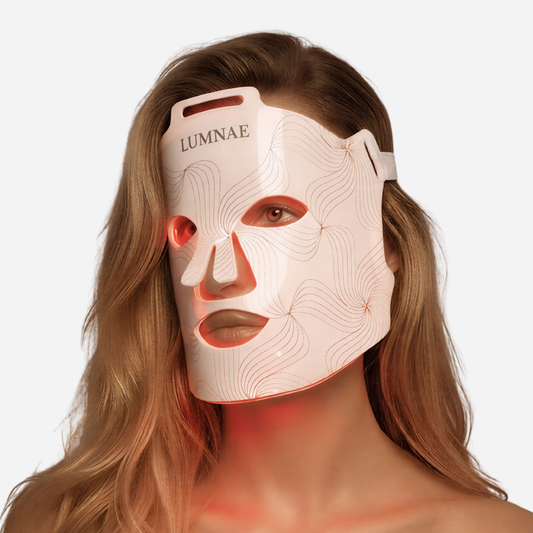
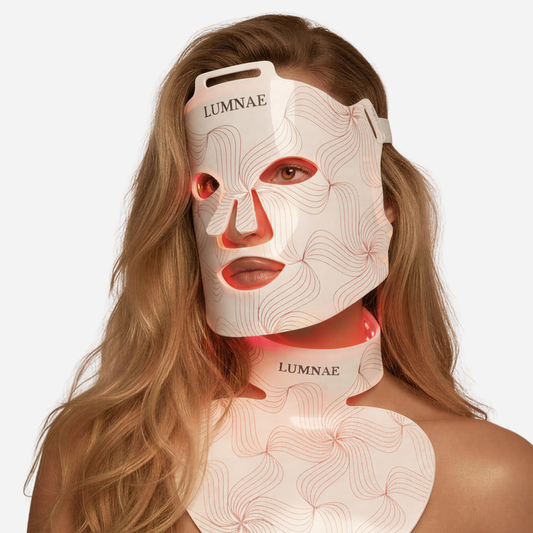
The Lumnae mask has been engineered as a professional-grade home device, strictly aligned with the biphasic dose response (the Arndt–Schulz law). All modes are pre-calibrated to remain within validated PBM therapeutic windows, avoiding both inhibitory and overstimulatory effects.
This equation is the foundation of the engineering behind every mode. Irradiance is the power that drives photons through the skin barrier. Energy (Joules) represents the total dose your cells receive to trigger repair. Without this calculation, light therapy is merely a glow — with it, it becomes a calibrated treatment. Every mode below is the result of this formula, solved for a specific therapeutic target.
What each wavelength does at the cellular level
Primary interaction with mitochondrial cytochrome c oxidase, leading to increased ATP synthesis, fibroblast activation, collagen signalling and dermal repair processes.
References: Karu et al. — mitochondrial photoacceptors and action spectra · PBM mechanisms in tissue repair and inflammation modulation (PMC)
Photo-excitation of endogenous porphyrins within Cutibacterium acnes, resulting in selective bacterial inactivation without thermal damage to surrounding tissue.
Reference: Dai et al. — LED phototherapy mechanisms in dermatology (PMC)
Modulation of superficial vascular responses, microcirculation balance and erythema-associated inflammatory signalling.
Supporting reference: PBM effects on vascular and inflammatory pathways (PMC)
Deeper dermal and sub-dermal penetration enabling modulation of inflammation, microcirculation and regenerative signalling beyond the superficial dermis.
References: Karu et al. — near-infrared mitochondrial absorption · Penetration depth analysis: science vs marketing claims
The architecture behind each 10-minute session
All modes are calibrated within photobiomodulation therapeutic windows described in published PBM literature on dose-response and therapeutic ranges.
Supports skin barrier recovery, fibroblast activation and post-inflammatory repair signalling.
Targets vascular tone uniformity, erythema modulation and superficial microcirculation balance.
Combines surface-level collagen signalling with deeper structural and regenerative support.
High-fluence mitochondrial priming designed to enhance cellular resilience against daily environmental stressors.
Targeted bacteriostatic action on inflammatory acne pathways without UV or thermal exposure.
Designed to prevent receptor saturation while respecting biological PBM timing — each wavelength's mechanism is given full effect before the next phase begins.
Delivering multiple wavelengths simultaneously at full intensity can risk receptor competition and reduced individual efficacy. Mode 6's sequential architecture — yellow, then red+NIR, then blue — allows each wavelength's distinct biological mechanism to act with full effect before the next phase begins, maximising the cumulative therapeutic outcome within a single 10-minute session.
What is the Arndt-Schulz law and why does it matter for LED therapy?
What does 660nm red light target at the cellular level?
How does blue light at 415nm destroy acne bacteria?
Why does Lumnae use sequential dosing in Mode 6?
- Each of Lumnae's 6 modes is a calibrated response to a specific evidence-based spectral target — not an arbitrary colour combination.
- All modes are pre-calibrated within the biphasic dose-response window described by the Arndt-Schulz law, avoiding both under- and over-stimulation.
- Mode 6's sequential architecture exists specifically to prevent receptor saturation and maximise the therapeutic effect of each wavelength.
488 medical-grade LEDs, 4 evidence-based wavelengths, 6 pre-calibrated modes. FDA-cleared. Available now with free UAE delivery.
Explore the Lumnae LED MaskThis article references published photobiomodulation literature for educational purposes and does not constitute medical advice. Lumnae is intended for cosmetic skin maintenance. Individual biological responses may vary.