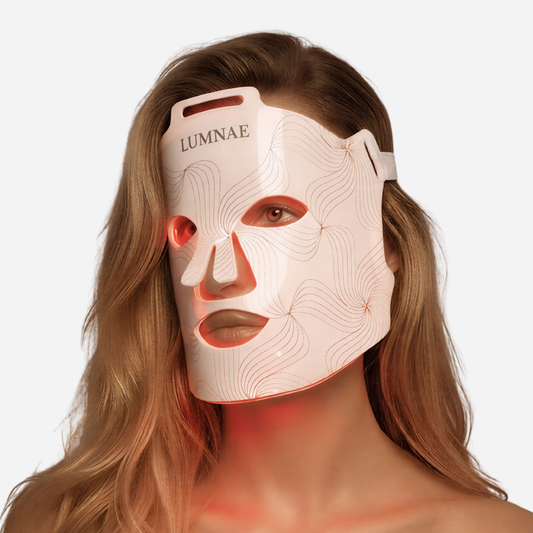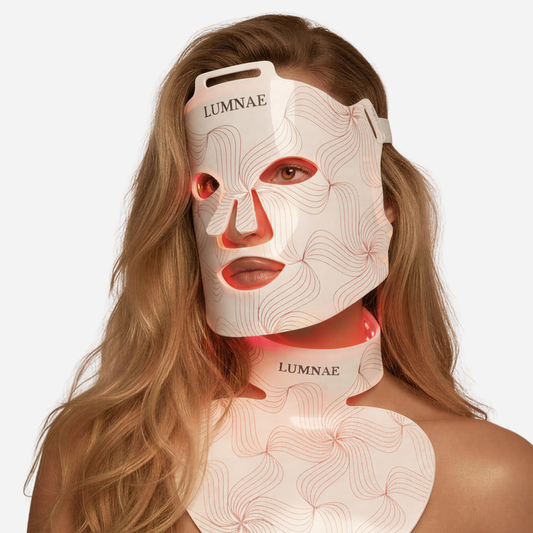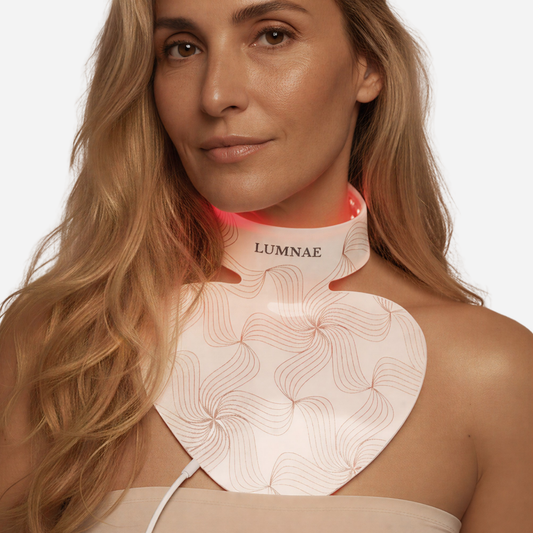
First: what each mode actually does
Before choosing a mode, spend 60 seconds here. Each Lumnae mode uses a different combination of light wavelengths — and each wavelength does a different job in your skin. Once you understand this, the right mode becomes obvious.
M1
Repairing — Red light only
Calms inflammation, repairs the skin barrier, supports healing. The gentlest mode and the safest starting point for any skin type.
M2
Rejuvenation — Yellow + Red
Targets dark spots and uneven tone. Yellow light directly slows down the melanin production process that creates hyperpigmentation.
M3
Anti-Aging — Red + Near-Infrared
Stimulates collagen at two skin depths simultaneously. The strongest anti-wrinkle and firming mode in the device.
M4
Morning — Yellow + Red + NIR
The most powerful mode overall (up to 45 mW/cm²). Boosts circulation and skin vitality. No blue light — safe before going outdoors.
M5
Anti-Acne — Blue light only
Destroys acne-causing bacteria at the skin surface. Always follow with red light (M1) in the same session.
M6
Bedtime — Sequential: Yellow → Red+NIR → Blue
Runs three phases in 10 minutes. A gentler multi-tasking evening mode — not all at once, but one after the other.
About Mode 6 — sequential, not simultaneous
Mode 6 does not deliver all wavelengths at the same time. It runs as a timed sequence: Yellow (590nm) for 3 minutes, then Red + Near-Infrared (660+850nm) for 5 minutes, then Blue (415nm) for 2 minutes. The anti-inflammatory red phase runs before the antibacterial blue phase — this is intentional. Total session: 10 minutes.
Now: find your skin concern
Each card shows the best mode for your concern and an alternative if the first one doesn't suit your skin. The alternative is not a follow-up — it replaces the primary on that day.
Acne, blackheads, oiliness
If skin too reactive for blue light
M6 Bedtime
Important: After M5, always run M1 (red light) in the same session — blue light creates inflammation that red light resolves. For Fitzpatrick III–VI skin (most GCC skin tones): start M5 at Level 1 and monitor for any darkening. · 5× per week for active acne.
Inflammatory acne / sensitive breakouts
After 2 weeks, you can add
M5 Anti-Acne
Red light alone (M1) has shown strong results for inflammatory acne — it calms the immune response and normalises sebum without any blue light risk. Use M1 for 2 weeks first, then add M5 at Level 1 on 2 sessions per week if skin is stable. Always follow M5 with M1 in the same session. · 4–5× per week.
Wrinkles, fine lines, firmness
M3 stimulates collagen at two skin depths (660nm in the dermis, 850nm deeper). Visible firmness begins at week 3–4; line reduction from week 6–8. Use M4 daily in the morning — it is the most powerful mode in the device and complements M3's evening work. · M3 4–5× per week · M4 daily.
Dark spots, hyperpigmentation, uneven tone
Best mode
M2 Rejuvenation
Never use blue light (M5 or M6) on the same day as M2. Blue light at 415nm activates a melanin-stimulating pathway (OPN3) in Fitzpatrick III–VI skin — the opposite of what M2 does. · Use M2 at Level 1–2 only. Follow with niacinamide serum. Apply tinted iron oxide SPF every morning. · 4× per week.
Redness, sensitivity, rosacea
M1 uses a single wavelength with no blue light — the minimum stimuli option for reactive skin. For rosacea or PIH-prone skin, M4 is particularly well-suited as an alternative — it contains no blue light, and its yellow + red + NIR combination is gentle enough for sensitive skin while remaining highly effective. · Start at Level 1. · 3–4× per week.
Dull, tired skin, lack of glow
M4 is the most powerful mode in the Lumnae mask (up to 45 mW/cm²) — it is not a light "prep" mode. Yellow + Red + NIR together boost lymphatic drainage, ATP production and tissue oxygenation — the three mechanisms behind genuine morning skin vitality. Use daily before SPF. · M4 daily · M6 evenings.
M1's 660nm red light reduces transepidermal water loss and actively supports the skin barrier — the structure that keeps moisture in. Particularly relevant in Dubai where air conditioning continuously strips the barrier overnight. Apply ceramide moisturiser immediately after. · 4–5× per week.
Barrier repair & post-procedure recovery
Alternative (after 1 week)
M3 Anti-Aging
After a chemical peel, laser, or any procedure that disrupts the skin, start with M1 only at Level 1 — it is the single most anti-inflammatory mode in the device. Introduce M3 after one week to begin deeper tissue remodelling. · Start daily, reduce to 4× per week once stable. Always at Level 1 initially.
Acne scars, texture irregularities
Alternative
M3 Anti-Aging
M1 reduces post-inflammatory redness and surface discolouration. M3 goes deeper — its 850nm NIR drives collagen remodelling that improves skin texture over time. Use M1 as the foundation and M3 as an upgrade once the active acne phase is under control. · 4× per week.
Dark circles, under-eye area
A 2025 clinical trial using 630+850nm combination (matching M3's wavelengths) showed 86.2% improvement in periorbital wrinkles after 12 weeks. M3's dual-depth action addresses both the structural (collagen loss) and vascular (dark pigmentation) drivers of under-eye appearance. · 4–5× per week.
The one rule that applies every time
Blue light + darker skin tones — read this once
Blue light at 415nm (used in Mode 5, and in Mode 6's final 2-minute phase) can stimulate melanin production in Fitzpatrick III–VI skin tones — which covers the majority of people in the UAE, Saudi Arabia and wider GCC. This does not make blue light unsafe, but it does mean you need to follow three rules every time:
1. Always start Mode 5 at Level 1 and monitor your skin for 2 weeks before advancing.
2. Always follow Mode 5 with red light (M1 or M3) in the same session — this resolves the oxidative stress that blue light creates.
3. Never use Mode 5 or Mode 6 on the same day as Mode 2 (Rejuvenation) — blue light directly opposes the melanogenesis-inhibiting work that M2 does.
Photosensitising skincare — applies to all modes
Do not apply retinoids (retinol, tretinoin), benzoyl peroxide, high-strength AHAs or vitamin C to your skin immediately before any LED session. These ingredients increase light sensitivity or interact unpredictably with specific wavelengths. Always start every session on clean, product-free skin. Apply your actives after the session.
The science behind each mode
How the wavelengths work, the exact irradiance levels, and what the clinical research says — for those who want to go deeper.
| Mode |
Wavelengths |
Level 1 |
Level 2 |
Level 3 |
Energy · L3 · 10 min |
|
M1 Repairing |
660nm · Red |
15 mW/cm² |
18 mW/cm² |
22 mW/cm² |
13.2 J/cm² |
|
M2 Rejuvenation |
590nm + 660nm |
20 mW/cm² |
25 mW/cm² |
30 mW/cm² |
18 J/cm² |
|
M3 Anti-Aging |
660nm + 850nm |
20 mW/cm² |
25 mW/cm² |
30 mW/cm² |
18 J/cm² |
|
M4 Morning |
590nm + 660nm + 850nm |
25 mW/cm² |
34 mW/cm² |
45 mW/cm² |
27 J/cm² |
|
M5 Anti-Acne |
415nm · Blue |
13 mW/cm² |
18 mW/cm² |
23 mW/cm² |
13.8 J/cm² |
|
M6 Bedtime |
Sequential: 590 → 660+850 → 415nm |
Matches each phase's single-mode irradiance |
~11 J/cm² combined |
Mode 4 is the most powerful mode in the mask. A pulse mode at 10Hz is also available across all settings for enhanced mitochondrial stimulation.
Red light at 660nm is absorbed by cytochrome c oxidase in your cells' mitochondria — this boosts energy (ATP) production and reduces the inflammatory signals (IL-1β, TNF-α) responsible for redness, irritation and post-acne recovery. It also activates fibroblasts for collagen synthesis and helps reduce transepidermal water loss, directly supporting the skin barrier. One study showed red light alone produced an 87.7% reduction in inflammatory acne after 12 weeks. It does not stimulate melanogenesis — safe for all skin tones at any level.
Redness & sensitivity Inflammatory acne Acne scars Barrier repair Dryness After M5 sessions
Yellow light at 590nm works on hyperpigmentation through two mechanisms: it induces autophagy (a clean-up process) in melanocytes that slows melanin production, and it reduces VEGF (a vascular growth factor) in the endothelial cells linked to the blood-vessel component of conditions like melasma. A published clinical study using 590nm LED confirmed significant improvement in pigmentation with consistent use. The 660nm red component adds anti-inflammatory support that helps calm the redness often associated with post-inflammatory marks.
Dark spots PIH / melasma Uneven tone Post-acne marks (red/brown) Dullness (secondary)
The combination of two wavelengths at different depths makes M3 the strongest collagen-stimulating mode in the mask. 660nm red activates fibroblasts in the upper dermis. 850nm near-infrared penetrates deeper — into the lower dermis and subcutaneous tissue — where structural protein remodelling happens. Neither wavelength stimulates melanogenesis, making M3 safe for all skin tones. A 2025 sham-controlled clinical trial using 630+850nm (closely matching M3) confirmed 86.2% improvement in periorbital wrinkles after 12 weeks.
Fine lines & wrinkles Loss of firmness Dark circles Acne scars (texture) Post-procedure repair
Mode 4 is the highest-irradiance mode in the Lumnae mask — up to 45 mW/cm² at Level 3, delivering 27 J/cm² in 10 minutes. This is more than double the irradiance of Mode 1. Yellow (590nm) activates lymphatic drainage and microcirculation. Red (660nm) boosts cellular ATP. NIR (850nm) supports deep tissue oxygenation. Crucially, M4 contains no blue light — it is completely safe before outdoor UV exposure. Skin treated with M4 absorbs serums and SPF more effectively. Start at Level 1–2 for the first two weeks given the high power.
Dullness & lack of glow Daily morning ritual Pre-makeup prep PIH-prone skin (safer alt for M6) Rosacea (safer alt for M6)
Blue light at 415nm is absorbed by porphyrins produced by Cutibacterium acnes bacteria as part of their normal metabolism. This triggers singlet oxygen production inside the bacterial cell, destroying it — a targeted mechanism that does not affect surrounding human tissue. Repeated sessions also progressively reduce sebum production, creating a more stable skin environment over time. Consistency is key: 5 sessions per week builds the cumulative energy needed for sustained, meaningful results.
Active breakouts Blackheads Excess oiliness
Mode 6 delivers three wavelength phases in sequence — not simultaneously. The 5-minute Red+NIR phase in the middle drives the core repair and anti-inflammatory work. The 2-minute blue phase that follows maintains the antibacterial environment built up across your weekly sessions. Together, the sequence covers all four wavelengths in a single 10-minute evening ritual — making it the most versatile bedtime mode in the device.
Acne maintenance Multi-concern evening ritual Dark circles (alt) Dull skin (alt)
Ready-made weekly protocols
Copy the one that matches your concern — no need to figure out the structure yourself.
For acne (mild to moderate)
M5 then M1 — same session — 5× per week
CleanseRemove all SPF, makeup and actives. Pat dry. Wait 60 seconds.
M5 · 10 minAnti-Acne (blue 415nm) at Level 1 for weeks 1–2. Advance to Level 2 after 2 weeks if no pigmentation change is seen.
M1 · 10 minRepairing (red 660nm) immediately after M5 — do not remove the mask between modes. This is the healing phase: red light resolves inflammation and accelerates recovery while the skin is most receptive.
AfterNiacinamide serum + light moisturiser. No retinoids, AHAs or benzoyl peroxide same evening.
For dark spots and hyperpigmentation
M2 evenings · M4 mornings · No blue light on M2 days
MorningM4 Morning (590+660+850nm) — 10 min. Then vitamin C serum + tinted iron oxide SPF. Every single day.
Evening · 4×/wkM2 Rejuvenation (590+660nm) at Level 1–2 — 10 min. Then niacinamide serum. Do not use M5 or M6 on M2 days.
TimelineFirst improvement in tone: week 4–6. Significant PIH reduction: week 8–12. SPF compliance matters more than session frequency.
For anti-ageing and collagen
M3 evenings · M4 mornings · Daily structure
Morning · dailyM4 Morning — 10 min. Then vitamin C + SPF.
Evening · 4–5×/wkM3 Anti-Aging — 10 min. Then peptide serum + hyaluronic acid + night cream.
RetinolUse on 2 non-LED evenings per week only — never the same evening as LED.
TimelineFirmer feel: week 3–4. Visible lines softening: week 6–8. Peak results: week 10–16.
For sensitive or reactive skin
M1 only — build slowly
Weeks 1–2M1 Repairing at Level 1 only — 10 min, 3× per week. Advance to Level 2 only when skin feels stable.
AfterCentella asiatica or panthenol serum + ceramide moisturiser. Nothing else.
Week 3+Add M4 (morning) if tolerated — no blue, so no risk. Introduce other modes only once skin is consistently stable over 4 weeks.
What to apply after each mode
LED sessions prime your skin to absorb serums more effectively. Applying the right ingredient immediately after amplifies the result.
| Mode |
Apply after |
Avoid same evening |
|
M1 Repairing |
Centella asiatica, Panthenol, or Ceramide moisturiser |
Retinoids, AHAs, Benzoyl peroxide |
|
M2 Rejuvenation |
Niacinamide serum (4–10%) |
Vitamin C, AHAs, M5 or M6 same day |
|
M3 Anti-Aging |
Peptide serum, then Hyaluronic acid |
Retinoids (use on non-LED nights) |
|
M4 Morning |
Vitamin C serum, then tinted iron oxide SPF |
Going outdoors without SPF — not an option in the UAE |
|
M5 → M1 (in sequence) |
Niacinamide serum after M1 completes |
Retinoids, BPO, vitamin C, AHAs same evening |
|
M6 Bedtime |
Ceramide moisturiser or sleeping mask |
Retinoids (use on non-LED nights) |
Frequently asked questions
Which LED mask mode is best for acne?
Mode 5 (Anti-Acne, 415nm blue light). Always follow it with Mode 1 (red light) in the same session — blue light destroys bacteria but creates inflammation that red light resolves. If your skin is too sensitive for Mode 5, use Mode 6 as an alternative (gentler overall), or start with Mode 1 alone for 2 weeks before introducing blue light.
Which LED mask mode is best for wrinkles?
Mode 3 (Anti-Aging, 660nm + 850nm near-infrared). It stimulates collagen at two skin depths simultaneously. Use 4–5× per week in the evening. A 2025 sham-controlled trial confirmed 86.2% improvement in periorbital wrinkles after 12 weeks with a closely matched wavelength combination. Mode 4 (Morning) is the alternative.
Which LED mask mode is best for dark spots?
Mode 2 (Rejuvenation, 590nm + 660nm), at Level 1 or 2 only. Yellow light at 590nm inhibits the melanin production process directly. The critical rule: never use Mode 5 or Mode 6 on the same day as Mode 2 — their blue light phase triggers the exact melanin pathway Mode 2 is trying to suppress. Always use tinted iron oxide SPF every morning.
Does Mode 6 use all wavelengths at the same time?
No. Mode 6 runs sequentially: Yellow (590nm) for 3 minutes → Red + NIR (660+850nm) for 5 minutes → Blue (415nm) for 2 minutes. Total: 10 minutes. The sequence is carefully ordered — the anti-inflammatory red phase runs first, then the antibacterial blue phase completes the session. It is a complete, timed programme in a single 10-minute session.
Which mode is most powerful — and is that a good thing?
Mode 4 (Morning Skincare) is the highest irradiance mode at up to 45 mW/cm² — more than double Mode 1. Higher power means more energy delivered to your skin per session, which is generally better for results — but it also means starting at Level 1 for the first two weeks to let your skin adapt. More power is beneficial when your skin is ready for it.
Is blue light safe for darker GCC skin tones?
Yes, with the right protocol. Blue at 415nm can trigger melanin production in Fitzpatrick III–VI skin via a pathway called OPN3. The answer is simple: always start at Level 1, always follow with red light in the same session, and never use blue light on a day you are treating dark spots. Follow these three rules and blue light is safe and effective for GCC skin tones.
Can I use the LED mask during Ramadan?
Yes. All six modes involve no ingestibles, no UV and no pharmaceutical agents. M4 in the morning before Suhoor and M3 or M6 in the evening after Iftar works well as a Ramadan structure. Apply moisturiser after every session — hydration matters more when systemic water intake is reduced during fasting hours.
How often should I use each mode?
Mode 4 (Morning): daily. Mode 5 (Acne): 5× per week. Mode 3 (Anti-Aging): 4–5× per week. Mode 2 (Dark spots): 4× per week. Mode 6 (Bedtime): 4–5× per week. Mode 1 (Repairing): 3–5× per week. Never use any mode more than once per day.
LS
Reviewed by
Lumnae Skincare Science Team
Clinical claims are referenced to peer-reviewed photobiomodulation literature including: Papageorgiou et al. (Br J Dermatol, 2000) · Dai et al. 590nm LED melasma study (Cells, 2022) · Park SH et al. periorbital wrinkle trial (Medicine Baltimore, 2025) · OPN3 blue light melanogenesis research (J Clin Med, 2023). Last reviewed April 2025. Consult a dermatologist for personalised advice.
The bottom line
- Understand the mode first — each one does a different job. Once you know what each wavelength does, choosing becomes obvious.
- Each concern has a best mode and an alternative. The alternative replaces the primary on that day — it is not a follow-up sequence.
- One exception: for acne, always run M5 then M1 in the same session. These two are a clinical sequence, not alternatives.
- Mode 4 is the most powerful mode in the mask. Mode 6 is sequential (Yellow → Red+NIR → Blue), not simultaneous.
- For GCC skin tones: blue light (M5 and M6) can stimulate melanin. Level 1 to start, always follow with red light, never on the same day as M2.
- Consistency beats intensity. 3–5 sessions per week, every week, matters more than any single session length or level.
Lumnae · 6 Modes · UAE & GCC
Six Modes. One Mask.
FDA-cleared, CE-certified, 488 medical-grade LEDs. Built for Dubai and GCC skin — year-round, no UV, no downtime.
Shop the Lumnae LED Mask ✦