
LED Mask for Skin Tightening: How Red and Near-Infrared Light Firms Your Face at Home
Share
LED Mask for Skin Tightening:
How Red Light Firms Your Face at Home
Skin laxity is not just an ageing process — in the UAE, it is accelerated by year-round UV. Here is the cellular mechanism behind how 660nm and 850nm light rebuild firmness, the clinical evidence, and the exact protocol.
Why skin loses firmness — and why the UAE makes it worse
Firmness comes from two structural proteins in the dermis: collagen, which provides rigidity and density, and elastin, which allows skin to snap back after movement. From the mid-20s, both decline at roughly 1% per year. The visible result is the progressive shift from plump, resilient skin to looser, thinner, more lined tissue.
In temperate climates, this is primarily a biological process. In the UAE, it is dramatically accelerated by photoageing — collagen degradation caused by UV radiation. At UV indices that regularly reach extreme levels year-round, every sun exposure triggers reactive oxygen species in the dermis that upregulate MMP-1: the enzyme responsible for collagen breakdown. The result is that skin in Dubai ages structurally faster than the same skin would in a cooler, lower-UV environment.
UV exposure → reactive oxygen species → MMP-1 upregulation → collagen degradation → reduced fibroblast capacity → accelerated laxity. This cycle runs year-round in the UAE. Red light therapy at 660nm interrupts it at two points simultaneously: suppressing MMP-1 (protecting existing collagen) and activating fibroblasts (rebuilding new collagen).
How LED light tightens skin — step by step
LED therapy does not tighten skin through heat or pressure. It works at the cellular level through a documented photobiological process called photobiomodulation (PBM). Here is the exact chain of events.
Photon absorption by cytochrome c oxidase
Red (660nm) and near-infrared (850nm) photons penetrate the dermis and are absorbed by cytochrome c oxidase — the terminal enzyme in the mitochondrial electron transport chain. This is the primary chromophore for these wavelengths, with absorption peaks that closely match both 660nm and 850nm.
ATP production increases
Photon absorption improves the efficiency of the electron transport chain, increasing ATP (cellular energy) production significantly. Fibroblasts — the cells responsible for producing collagen and elastin — use this extra energy to increase their synthesis output. More energy means more structural protein production.
Fibroblast activation and collagen gene expression
The downstream signalling cascade activates transcription factors that upregulate gene expression for type I and type III procollagen — the direct precursors of mature collagen fibres. Studies confirm upregulation of collagen and elastin genes in dermal fibroblasts exposed to red and near-infrared LED combinations.
MMP-1 suppression — protecting existing collagen
Simultaneously, PBM suppresses MMP-1 expression — the enzyme chronically upregulated by UV in UAE skin that degrades existing collagen. Clinical research has confirmed measurable reduction in MMP-1 levels in LED-treated tissue. New collagen is being built; existing collagen is being protected.
Elastin regeneration
Beyond collagen, LED therapy also stimulates elastin production — the protein responsible for skin's ability to spring back after movement. Elastin loss is the primary driver of the "crepe" texture and the inability of skin to recover after facial expressions. Multiple clinical investigations confirm elastin upregulation alongside collagen with red and NIR LED exposure.
660nm vs 850nm — two depths, one result
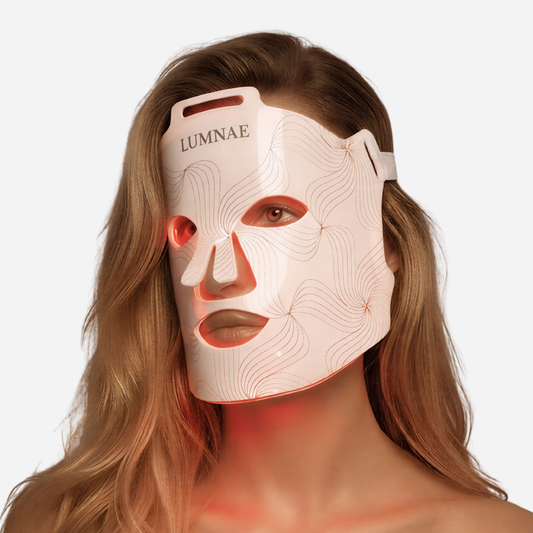
Mode 3 (Anti-Aging) in the Lumnae mask delivers both 660nm and 850nm simultaneously. They are not redundant — they address skin tightening at two different structural depths.
660nmSurface renewal, tone improvement, UV damage repair. Reduces the surface inflammatory signalling that inhibits fibroblast activity below.
660nm primaryThe highest density of fibroblasts for surface collagen. 660nm is maximally effective here — stimulating type I and III procollagen, suppressing MMP-1, activating nitric oxide for microcirculation. Fine lines and surface texture change here.
850nm primaryNear-infrared reaches the reticular dermis where the dense collagen networks responsible for structural firmness originate. 850nm activates deeper fibroblasts, improves elastin synthesis and increases collagen density at the structural level. Firmness and laxity change here.
850nm deep reachNIR continues into subcutaneous tissue, improving the microvascular infrastructure that delivers nutrients to the overlying dermis — supporting the entire repair environment.
A mask that only delivers 660nm (red only) cannot produce the same structural tightening results as one that combines 660nm + 850nm. The surface fine lines may improve, but the deeper structural laxity — the loss of the dense collagen network in the reticular dermis — requires 850nm to address.
What the research confirms
Multiple randomised controlled trials confirm 20–36% reduction in wrinkle severity and approximately 19% improvement in skin elasticity after 4–12 weeks of consistent red and near-infrared LED use. The 660nm wavelength specifically achieved approximately 30% reduction in wrinkle volume in direct comparison studies.
Source: Peer-reviewed clinical review of RCT data, published 2025. Based on multiple independent trials using 630–660nm and 830–850nm LED combinations.
In vitro and ex vivo studies using 640nm + 830nm LED combinations confirmed upregulation of collagen and elastin genes and proteins in dermal fibroblasts. The signalling cascade — from photon absorption through cytochrome c oxidase to procollagen gene expression — has been characterised in multiple independent laboratory investigations.
Source: Li W. et al. (2021). Low-level red plus near-infrared lights combination induces expressions of collagen and elastin in human skin in vitro. International Journal of Cosmetic Science, 43, 311–320.
A 2025 randomised, double-blind, sham-controlled trial using a 630nm + 850nm LED mask combination in 60 participants showed 86.2% improvement in periorbital wrinkle grading at 12 weeks, as confirmed by independent blinded evaluators. The sham group showed 16.7% improvement — confirming the active LED effect is genuine and not placebo.
Source: Park SH, Park SO, Jung JA. Medicine (Baltimore) 2025;104:e41596. PMC11835066
The Lumnae skin tightening protocol
Mode 3 (Anti-Aging, 660nm + 850nm) at up to 30 mW/cm² and 18 J/cm² per 10-minute session is the primary tightening mode in the Lumnae mask. Here is the complete weekly structure.
Mode 3 evenings · Mode 4 mornings · 3–5× per week
The post-session ingredients that amplify Mode 3
What to expect and when
Skin feels different before it looks different
ATP production increases from the first session. By week 1–2 most users notice skin feels calmer, slightly more hydrated and less reactive. Fibroblast activation is underway but newly synthesised procollagen has not yet matured into visible collagen fibres.
Firmer feel — skin responds differently to touch
Cumulative collagen deposition begins to produce a detectable change in skin density. Users consistently describe skin as feeling "bouncier" or "more resilient" — not yet visible in the mirror, but palpable. Microcirculation improvements produce a visible improvement in overall tone and luminosity.
Visible fine line reduction — first mirror changes
Collagen fibres are now present in sufficient quantity to produce visible structural changes. Fine lines — particularly around the eyes, forehead and lip border — soften measurably. Skin texture improves. Pore appearance reduces as collagen density in the surrounding dermis increases.
Peak collagen maturation — structural tightening
Collagen fibres laid down from week 4 onwards mature and strengthen. Maximum visible firmness, elasticity and line reduction develop in this window. The 2025 sham-controlled trial confirmed 86.2% periorbital improvement at 12 weeks. Maintain at 3× per week after week 16 to sustain results.
Skin tightening stops at the jawline for most routines — it should not
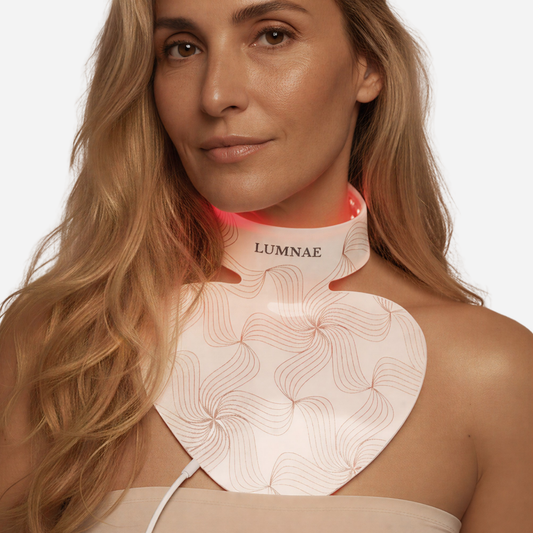
The neck and décolleté show the earliest signs of collagen loss and skin laxity — the tissue here is thinner, receives significant UV exposure, and is almost never included in LED routines designed for the face alone.
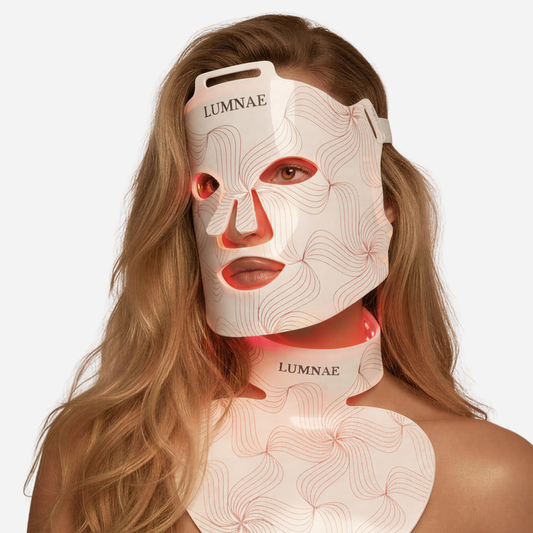
The Lumnae Face & Neck Kit includes a dedicated neck mask delivering the same 660nm + 850nm wavelengths across the full neck and chest area. Used together with the face mask, it delivers complete structural collagen stimulation from forehead to décolleté in a single 10-minute session — addressing the full visible ageing zone, not just the part most devices stop at.
- Skin tightening from LED therapy works through genuine cellular biology — not heat, not temporary hydration. Fibroblasts produce more collagen and elastin; MMP-1 (the degradation enzyme) is suppressed simultaneously.
- 660nm and 850nm address skin firmness at two different structural depths. A red-only mask cannot produce the same structural results as the 660+850nm combination in Mode 3.
- Multiple independent RCTs confirm 20–36% wrinkle severity reduction and ~19% elasticity improvement. The 2025 sham-controlled trial confirmed 86.2% periorbital improvement at 12 weeks.
- In the UAE, photoageing from year-round UV accelerates collagen loss faster than intrinsic ageing alone. LED therapy is the only non-invasive intervention that simultaneously suppresses the degradation enzyme and rebuilds new collagen.
- The timeline is real: firmer feel at weeks 3–4, visible tightening at weeks 6–8, peak structural results at weeks 10–16. Consistency at 3–5 sessions per week determines results more than any other variable.
- The neck and décolleté age structurally at the same rate as the face — and most routines leave them untreated. The Face & Neck Kit addresses the complete visible ageing zone in one session.
488 medical-grade LEDs. 660nm + 850nm. Up to 30 mW/cm². FDA-cleared, CE-certified, ISO 13485. Available now with UAE delivery on lumnae.com.
Discover the Lumnae LED MaskThis article is intended for informational purposes and does not constitute professional medical advice. Clinical statistics cited are sourced from peer-reviewed publications. Individual results may vary. Consult a licensed dermatologist for personalised advice.