
Red Light Therapy for Dark Spots & Hyperpigmentation | Lumnae
Share
Red Light Therapy for Dark Spots
& Hyperpigmentation:
Does It Really Work?
Dark spots and uneven skin tone are among the most common concerns for skin in the UAE. Here is what the science says about red light therapy — and what to realistically expect.
Hyperpigmentation and the UAE climate
Hyperpigmentation — dark spots, post-inflammatory marks, melasma — is one of the most prevalent skin concerns across the UAE and GCC. Year-round UV exposure significantly accelerates melanin production, making dark spots more stubborn and more common here than in many other regions.
Most treatments for hyperpigmentation rely on exfoliating acids, chemical peels or laser — all of which require downtime and can cause sensitivity in darker skin tones. Red light therapy offers a different mechanism: it works at the cellular level, without UV, without heat, and without disrupting the skin barrier.
How red light therapy targets pigmentation
Hyperpigmentation is caused by overactive melanocytes — skin cells that produce melanin. The process is triggered and accelerated by UV exposure, inflammation (from acne, eczema or injury), and hormonal changes.
Red light therapy addresses pigmentation through two distinct mechanisms depending on the wavelength used:
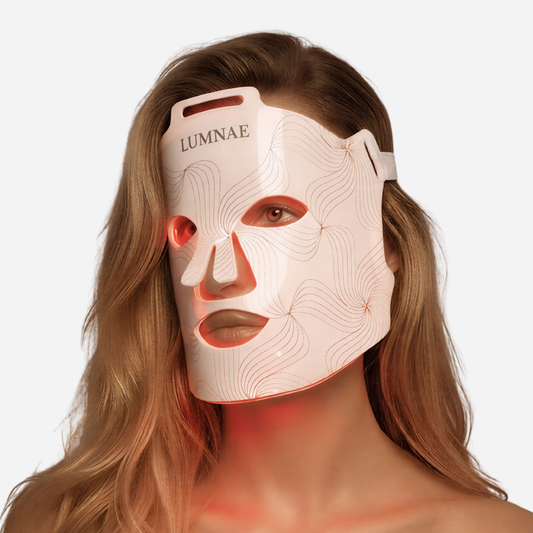
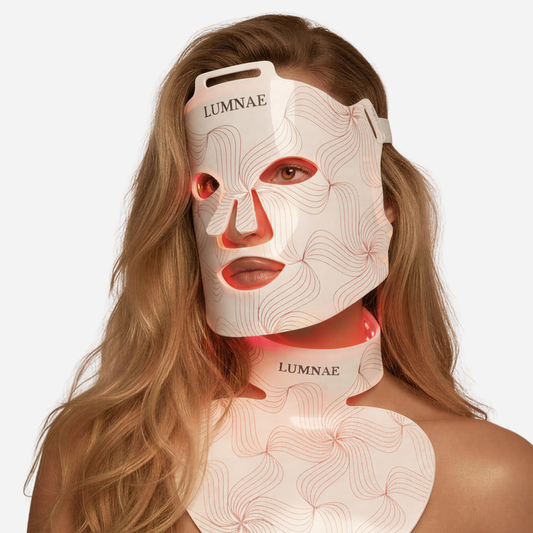
Using 590nm and 660nm together — as in Mode 2 (Rejuvenation) on the Lumnae mask — addresses both sides of the pigmentation equation simultaneously: reducing new melanin formation while accelerating the turnover of existing pigmented cells. This is why combination protocols consistently outperform single-wavelength approaches in the literature.
Not all dark spots are the same
Post-inflammatory hyperpigmentation (PIH)
PIH — the dark marks left after acne, eczema or skin irritation — responds well to red light therapy. The combination of anti-inflammatory action (590nm) and cellular repair (660nm) addresses both the residual pigmentation and the inflammation that feeds it. This is the type that most commonly responds within 4–6 weeks.
Sun-induced dark spots
UV-triggered spots and age spots respond to 590nm's tyrosinase inhibition, though more gradually. Consistent sessions over 8–12 weeks show the clearest results, combined with rigorous SPF use to prevent re-darkening.
Melasma
Melasma — hormonally driven pigmentation — is the most complex to treat with any modality. Red light therapy can support overall skin brightness and reduce the appearance of melasma over time, but it is not a standalone treatment. Always work alongside a dermatologist for active melasma.
A realistic timeline for results
Consistency is the single most important variable — results accumulate over weeks, not from individual sessions. Missing sessions resets some of the progress, particularly for melanin inhibition.
The protocol for hyperpigmentation
In the UAE climate, SPF is the most critical part of any pigmentation protocol — more important than the treatment itself. LED therapy addresses existing melanin; SPF prevents new melanin from forming. Without both, results will be significantly slower and less stable.
Can red light therapy fade dark spots?
Which LED mask mode is best for hyperpigmentation?
Is LED light therapy safe for dark skin tones?
How long does it take for LED therapy to fade dark spots?
Can I use LED therapy alongside other pigmentation treatments?
Is hyperpigmentation more common in the UAE climate?
- 590nm yellow light inhibits tyrosinase — the enzyme that produces melanin — making it the most targeted wavelength for hyperpigmentation.
- Mode 2 (Rejuvenation) combines 590nm and 660nm for a dual approach: reducing new pigmentation while accelerating cell turnover.
- Realistic results: initial brightening from week 2–3, visible spot fading from week 4–8 with consistent use.
- SPF 50+ daily is non-negotiable — without sun protection, LED therapy cannot outpace new melanin formation in the UAE climate.
488 medical-grade LEDs · 4 wavelengths · Mode 2 for pigmentation · FDA-cleared · Free UAE delivery.
Shop the Lumnae LED Mask →This article is for educational purposes and does not constitute medical advice. Always consult a qualified dermatologist before starting any new skincare treatment, particularly if you have active melasma or are taking photosensitising medication.