Best LED Mask for Pigmentation & Dark Spots | Lumnae UAE
Share
Best LED Mask for Pigmentation
& Dark Spots: The GCC Buyer's Guide
Not all LED masks treat pigmentation — and most do not explain why. This guide covers the exact wavelength mechanism behind yellow light, the clinical evidence, the critical protocol rules for GCC skin, and why Mode 2 exists.
Why dark spots are more persistent in the UAE — and what actually helps
Hyperpigmentation is one of the most common and most frustrating skin concerns in the UAE and wider GCC. It is not simply a cosmetic issue — it is a biological consequence of two compounding factors that are specific to this environment and to the skin tones that predominate here.
The first is UV exposure. The UAE receives year-round solar radiation at UV indices that regularly reach extreme levels. Every UV exposure episode triggers the melanogenesis cascade — stimulating melanocytes to produce more melanin — and in Fitzpatrick III–VI skin (the dominant phototype across the GCC), the melanin response is both stronger and longer-lasting than in lighter skin types.
The second is post-inflammatory hyperpigmentation (PIH). Every pimple, every scratch, every bout of redness leaves behind a dark mark in darker skin tones — because the inflammatory cascade directly activates the melanin pathway. PIH in Fitzpatrick III–VI skin can persist for months or years without active treatment.
The result: in the GCC, hyperpigmentation is not a mild cosmetic concern. It is the dominant skin challenge for the majority of the population — and it requires a treatment approach calibrated for the specific biology of darker skin, not the European skin type most skincare brands design for.
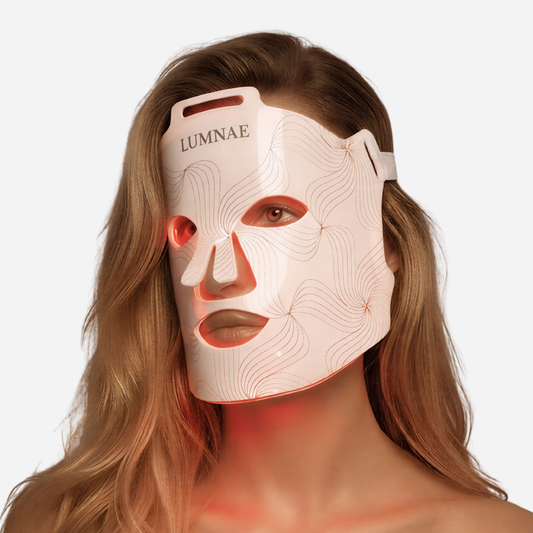
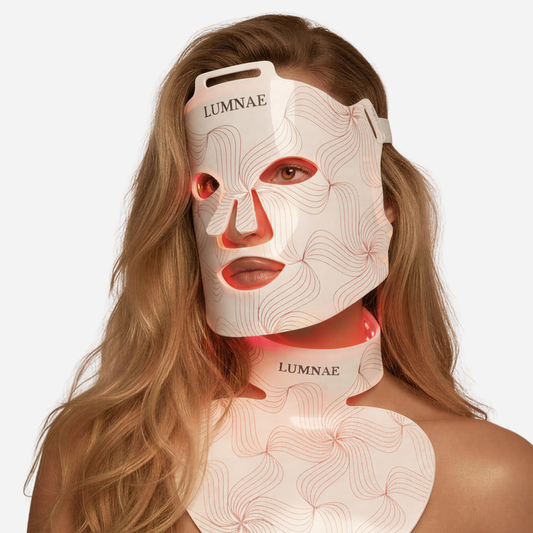
Most LED masks on the market focus on 660nm red light and 850nm near-infrared — excellent for collagen and recovery, but with no direct mechanism for melanogenesis inhibition. The wavelength with the strongest clinical evidence for treating dark spots is 590nm yellow light — and most masks simply do not include it. The Lumnae mask includes 590nm as a dedicated wavelength in Mode 2, specifically for this purpose.
How 590nm yellow light targets pigmentation at the cellular level
The mechanism by which yellow light reduces hyperpigmentation is not vague or theoretical — it is a documented, multi-pathway biological process that has been confirmed in independent peer-reviewed research. Here is exactly how it works:
Tyrosinase inhibition — blocking melanin production at the source
Tyrosinase is the key enzyme in melanin synthesis. 590nm LED photobiomodulation reduces tyrosinase activity in melanocytes, directly slowing the production of new melanin. Less active tyrosinase means less melanin deposited in the skin — which over weeks of consistent use translates to visibly lighter dark spots.
Autophagy induction — clearing existing melanin
Research from Huashan Hospital (Fudan University) demonstrated that 585–590nm yellow LED induces autophagy in melanocytes — a cellular self-cleaning process that breaks down and clears accumulated melanin pigment. This is not just prevention of new pigmentation; it is active removal of existing dark deposits.
VEGF and SCF suppression — the vascular-pigmentation link
Melasma and persistent hyperpigmentation in the GCC are not purely a melanocyte problem — they have a vascular component. Abnormal blood vessel activity (VEGF) and stem cell factor (SCF) both drive melanogenesis. A 2022 clinical study published in Cells confirmed that 590nm LED significantly reduced VEGF and SCF levels in vascular endothelial cells, simultaneously attacking both the vascular and melanin drivers of hyperpigmentation.
Anti-inflammatory action — preventing PIH recurrence
Post-inflammatory hyperpigmentation (PIH) is triggered by inflammation — the same cascade that produces a pimple or a redness reaction. 590nm yellow light and 660nm red light both suppress pro-inflammatory cytokines in the dermis, reducing the inflammatory signal that activates melanocytes. This means M2 treats existing dark spots while simultaneously reducing the likelihood of new ones forming from inflammation.
What the research confirms
590nm LED applied to human microvascular endothelial cells (HMEC-1) significantly reduced VEGF and SCF levels — the vascular signals that drive melanogenesis in melasma. The study demonstrated inhibition of HMEC-1 migration and tube formation via the AKT/PI3K/mTOR pathway. Researchers concluded 590nm LED "prominently attenuated erythema and hyperpigmentation in melasma" and proposed it as a novel therapeutic option for melasma.
Dai X et al. Cells 2022;11(24):3949. PMC: PMC9776419
A comprehensive review of photobiomodulation for melasma and hyperpigmentation confirmed that specific wavelengths — particularly amber/yellow (585–590nm) and red (630nm) — exert significant modulatory effects on tyrosinase activity, melanin gene expression and protein synthesis at radiant exposures of 1–20 J/cm². The review noted that 590nm LED is effective in improving dermal structure while simultaneously reducing erythema and neovascularisation — the two hallmarks of treatment-resistant melasma.
Review published in J Clin Med 2023;12(23):7488. doi:10.3390/jcm12237488
A study specifically in Asian subjects with Fitzpatrick III–IV skin investigated 590nm yellow light combined with 830nm near-infrared for hyperpigmentation prevention and treatment. The 10-subject cohort received treatments twice weekly for 4 weeks at 20 mW/cm² (yellow) and 50 mW/cm² (NIR). Results confirmed meaningful reduction in pigmentation at this protocol — notably using the same wavelength combination present in Lumnae's M2 mode (590nm + 660nm red, supported by 850nm NIR).
Published December 2024. Subject group: Asian skin, Fitzpatrick III–IV.
The evidence base for 590nm in hyperpigmentation treatment has strengthened significantly since 2022. The mechanism is not single-pathway — it is a coordinated suppression of melanin production, vascular driving signals and inflammatory triggers simultaneously. No topical ingredient addresses all three simultaneously in the same session.
What you must know before using any LED mask for pigmentation in the UAE
GCC skin tones (predominantly Fitzpatrick III–VI) respond differently to certain LED wavelengths than the European skin most LED brands design protocols for. There are specific rules that apply — ignoring them can worsen pigmentation rather than improve it.
Blue light at 415nm activates the OPN3 (Opsin-3) photoreceptor in melanocytes of Fitzpatrick III–VI skin — triggering melanogenesis. This means blue light (Mode 5 in the Lumnae mask) can worsen hyperpigmentation if used incorrectly. Always: start M5 at Level 1 only. Always follow M5 with M1 (red light) in the same session. Never use M5 on the same day you treat dark spots with M2. If your primary concern is pigmentation, consider whether you need M5 at all.
Yellow light (590nm) and red light (660nm) — the two wavelengths in Mode 2 — carry no melanogenesis risk. They are specifically indicated for hyperpigmentation across all skin tones. Mode 2 at Level 1–2 is the appropriate setting for GCC skin treating dark spots. Level 3 is not recommended for pigmentation treatment — more is not better here; consistent moderate dosing outperforms occasional high-intensity sessions.
The Lumnae M2 protocol for dark spots and hyperpigmentation
Mode 2 evenings · Mode 4 mornings · 3–5× per week
Post-session ingredients that amplify M2
The dark spots timeline — realistic expectations
Tone evenness improves — spots unchanged
The anti-inflammatory action of M2 begins immediately — skin generally looks calmer, more even and less reactive. Individual dark spots have not yet faded. The tyrosinase inhibition is underway at the cellular level but has not yet produced visible surface change.
Brightening — overall luminosity improves
Most users notice a general brightening and luminosity improvement before individual spots fade. This reflects the lymphatic and microcirculation improvements from 590nm — better drainage of metabolic waste, improved cellular turnover. Spots may appear slightly less defined at the edges.
Visible spot fading — surface pigmentation reduces
Surface-level dark spots (recent PIH, post-acne marks, UV spots) begin to visibly fade. Clinical studies confirm meaningful improvement at 8 weeks with consistent 590nm LED use. Take your reference photo now — the difference from week 1 is where progress is most visible.
Deeper pigmentation — melasma and older spots
Deeper dermal pigmentation (melasma, long-standing sun damage) responds on a longer timeline. Consistent M2 use across 10–16 weeks, combined with tinted SPF and niacinamide, produces cumulative improvement. Maintenance at 2–3 sessions per week sustains the inhibited tyrosinase activity and prevents repigmentation.
- The wavelength that treats dark spots and hyperpigmentation is 590nm yellow light — not red or near-infrared. Most LED masks do not include it. The Lumnae mask does, in Mode 2.
- 590nm inhibits melanogenesis through three simultaneous pathways: tyrosinase suppression, autophagy-driven melanin clearance, and vascular signal (VEGF/SCF) reduction. No topical ingredient addresses all three simultaneously.
- For GCC skin tones (Fitzpatrick III–VI), the protocol rules are specific: M2 at Level 1–2 only, tinted iron oxide SPF every morning without exception, never M2 and M5 on the same day.
- The timeline is real but requires patience: brightening from week 3–4, visible spot fading from week 5–8, deeper pigmentation at week 10–16. Consistency matters more than intensity.
- The UAE's year-round extreme UV and the stronger melanin response of GCC skin mean pigmentation is more persistent here than in temperate climates. Active treatment (590nm LED) combined with consistent tinted SPF is the evidence-based response.
488 medical-grade LEDs. 590nm yellow + 660nm red. FDA-cleared, CE-certified, ISO 13485. The only LED mask in the UAE with a dedicated yellow light pigmentation mode — available now on lumnae.com.
Discover the Lumnae LED MaskClinical claims referenced to published peer-reviewed research. Individual results may vary. This article is for informational purposes and does not constitute medical advice. Consult a licensed dermatologist for personalised guidance on hyperpigmentation treatment.