
LED Face Masks — Do They Actually Work? The Honest Answer in 2026
LED face mask searches have grown 34% on Google and TikTok this year. Everyone has seen the red glow selfies. But behind the hype is a real question that deserves a real answer — backed by science, not marketing.

Short answer: yes, LED face masks work — but not all of them, not for everything, and not the way most brands want you to believe. The science behind photobiomodulation (PBM) is solid and well-documented. The problem is that the technology is only as good as the device delivering it.
Here is the honest breakdown — what the research actually says, what makes a mask effective, and what to ignore.
What LED Light Therapy Actually Does
LED face masks work through a mechanism called photobiomodulation. Specific wavelengths of light are absorbed by Cytochrome C Oxidase — the key enzyme in your mitochondria — triggering a cascade of cellular responses: more ATP production, reduced oxidative stress, decreased inflammation and accelerated cellular repair.
This is not a new discovery. The underlying science has been studied for over 50 years with more than 5,000 peer-reviewed publications. What is new is the accessibility — devices that once existed only in dermatology clinics are now available for home use at a fraction of the per-session cost.
The key point: LED therapy is not placebo. The biological mechanism is real, documented and reproducible. What varies enormously is whether a specific device delivers enough light, at the right wavelengths, for long enough to trigger that mechanism.
What Does the Evidence Actually Say — Per Skin Goal
Why Most LED Masks on the Market Do Not Work Well
This is the part most brands skip. The science is real — but the device has to actually deliver a therapeutic dose. And most cheap LED masks simply do not.
The dose problem
Photobiomodulation follows a biphasic dose response — too little light produces no effect, too much can inhibit results. The therapeutic window for skin applications typically sits between 5 and 30 joules per centimetre squared (J/cm²) per session, depending on the goal.
To deliver that dose, a mask needs sufficient irradiance — the measure of light intensity at the skin surface. Clinical research typically uses devices delivering between 10 and 50 mW/cm² at contact. Many consumer masks advertise impressive LED counts but deliver a fraction of this irradiance, producing sessions that are cosmetically useless.
The wavelength problem
Not all wavelengths are equal. The most clinically supported windows are 630–670nm (red) and 810–850nm (near-infrared) for anti-aging and repair, and 415nm (blue) for acne. A mask that adds ten wavelengths but splits its power too thinly delivers less therapeutic benefit per wavelength than one with four well-powered wavelengths. More is not always better — balance is.
The consistency problem
LED therapy is cumulative. The most common reason people do not see results is not the device — it is inconsistent use. Three to five sessions per week for a minimum of eight weeks is the baseline for measurable outcomes. A mask you stop using after two weeks will not work, regardless of its specifications.
What to Look For When Buying an LED Mask in 2026
- Irradiance data — the brand should publish mW/cm² at contact distance. If they only list wattage or LED count, that tells you nothing about dose.
- Fluence per session — look for J/cm² per mode. This tells you whether a 10-minute session actually delivers a therapeutic dose or just a pleasant glow.
- Clinically relevant wavelengths — 660nm and 850nm for anti-aging, 415nm for acne, 590nm for redness. Any additional wavelengths should be powered adequately, not token additions.
- FDA clearance — not FDA "registered" or "compliant" — cleared. This means the device has undergone review as a Class II medical device.
- Medical-grade silicone — anything sitting against your face daily should be biocompatible and tested for skin contact (ISO 10993).
- Realistic claims — any brand promising visible results in one week or claiming their device replaces Botox should be treated with scepticism. The good ones cite timelines of 4–12 weeks.
The Clinic vs. Home Debate
Professional LED treatments in a clinic are not the gold standard simply because they are clinical — they are the gold standard because they are consistent, properly dosed and supervised. The question is not clinic vs. home — it is dose vs. dose.
A single clinic session at AED 300–400 delivers one treatment. A quality home device used five times a week delivers 20 treatments per month at a fraction of that cost per session. For most skin goals, the compounding benefit of daily home use far outperforms occasional clinic visits — if the device is adequate.
LED face masks work when the device delivers a therapeutic dose at clinically validated wavelengths, used consistently over weeks. The science is not in question — the device quality is. In 2026, with hundreds of products on the market, the difference between a mask that transforms your skin and one that collects dust is almost entirely in the specifications — irradiance, wavelengths and FDA clearance. Read those numbers before you buy.
How LUMNAE Is Built Differently
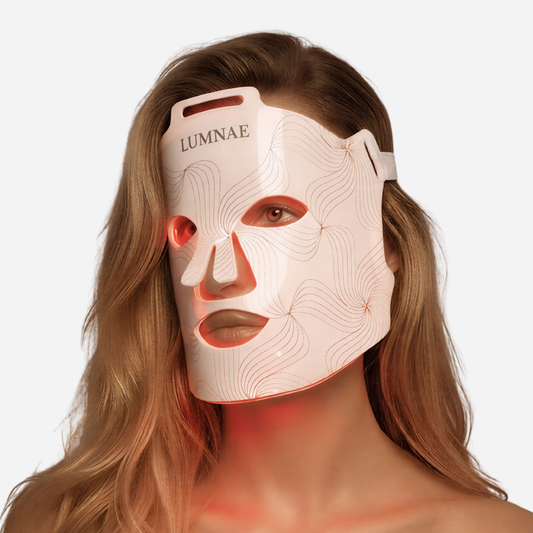
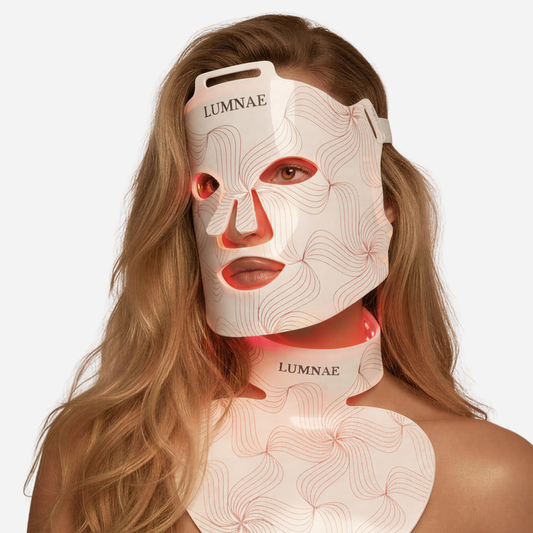
The LUMNAE LED Face Mask was engineered against the exact problems described above. 488 medical-grade LEDs in a 1:1:1:1 distribution across four clinically validated wavelengths — 415nm, 590nm, 660nm and 850nm — ensuring no wavelength is a token addition. Peak irradiance of 45 mW/cm² at contact distance. Six modes calibrated to deliver doses within the ranges identified in peer-reviewed photobiomodulation literature — from 13.2 J/cm² for targeted repair to 27 J/cm² for full-spectrum activation.
FDA 510(k) cleared. ISO 13485 certified manufacturing. Food-grade medical silicone. These are not marketing claims — they are the baseline for a device you trust against your face every day.
488 medical-grade LEDs · 4 wavelengths · FDA 510(k) cleared · Next-day delivery across UAE
Shop the LUMNAE Mask