
Red Light Therapy for Rosacea: Protocol for Sensitive Skin | Lumnae
Share
Red Light Therapy for Rosacea:
What Works, What Doesn't,
and the Protocol for Sensitive Skin
LED therapy is one of the few non-invasive interventions with genuine clinical evidence for rosacea — but only certain wavelengths, and not all rosacea types respond equally. Here is the honest breakdown.
What rosacea actually is — and why it is particularly challenging in the UAE
Rosacea is a chronic inflammatory skin condition characterised by persistent facial redness, visible blood vessels, flushing episodes and, in some cases, papules and pustules. It affects over 5% of individuals worldwide and is significantly more prevalent in people with lighter skin tones — though it occurs across all Fitzpatrick types.
In the UAE, rosacea presents a specific challenge: the dominant environmental triggers — heat, UV exposure and sudden temperature changes — are near-constant and unavoidable. The cycle of air-conditioned interiors at 18°C and outdoor temperatures at 40°C+ is one of the most reliable rosacea triggers known. For anyone managing rosacea in Dubai or Abu Dhabi, controlling environmental exposure is as important as any skincare intervention.
What makes rosacea particularly frustrating is its chronic nature — it cannot be cured, only managed. The goal of any intervention, including LED therapy, is to reduce flare frequency, calm persistent redness, support the skin barrier and improve quality of life. That framing matters: LED therapy is a management tool, not a cure.
The UAE's year-round UV index (reaching 11–12 in summer) and extreme heat are among the most potent rosacea triggers. Unlike temperate climates where rosacea sufferers get a natural break in winter, the UAE offers no seasonal respite. This makes consistent skin barrier support — which red and yellow LED therapy directly provides — more valuable here than in most other markets.
Which rosacea types respond to LED therapy — and which do not
Rosacea is not one condition — it is a spectrum. Understanding which subtype you have determines whether LED therapy is likely to help, and how much.
Persistent facial redness, flushing, visible broken capillaries. The vascular component — the primary target of yellow and red LED wavelengths.
Strong LED responseRedness with acne-like bumps and pustules. LED addresses the inflammatory component but not the papules directly. Partial response.
Moderate LED responseSkin thickening, often affecting the nose (rhinophyma). LED therapy has limited evidence for this subtype. Not the primary indication.
Limited LED responseEye dryness, irritation and redness. Always requires ophthalmological management. LED masks should not be used near the eyes without goggles.
Not indicatedThe honest answer: Subtype 1 (erythematotelangiectatic) is where LED therapy has the strongest evidence — specifically for reducing the persistent redness and calming the vascular reactivity that drives flushing. Subtype 2 has partial benefit. Subtypes 3 and 4 are outside the indication for home LED devices.
How 590nm and 660nm address the biology of rosacea
Rosacea is not simply a "redness problem" — it has a specific underlying biology involving vascular dysregulation, chronic inflammation and a compromised skin barrier. Understanding which part of that biology each wavelength targets explains why the combination of yellow and red light is more effective than either alone.
A combination of 590nm (25 mW, 22.5 J) and 830nm (50 mW, 45 J) LED, 5 minutes each, reduced erythema and downregulated the expression of angiogenesis markers (CD31) and inflammatory mediators (S100A9 and p65) in a mouse model of rosacea. The study concluded that 590nm directly targets the vascular component of rosacea through inhibition of HMEC-1 migration and tube formation.
Galache TR et al. Photodermatol Photoimmunol Photomed 2024. doi:10.1111/phpp.12935
In a clinical case series published in the Journal of Clinical and Aesthetic Dermatology, two of four rosacea patients treated with yellow LED (590nm) noted a confirmed photographic reduction in erythema. The erythematotelangiectatic component was significantly more responsive than the inflammatory component — consistent with the vascular mechanism of 590nm. Red LED (660nm) was shown to increase the minimal erythema dose, equivalent to approximately SPF 15 protection against UV-induced redness, after 5–10 sessions.
JCAD Clinical Review · PMC4479368
A case report documented LED therapy combining blue and red light reducing erythema, burning and itching in rosacea patients after 5 sessions, with further improvement at 10 sessions. A systematic review in Lasers in Medical Science confirmed that light-based therapies demonstrate efficacy for reducing redness in rosacea — with the strongest evidence for non-thermal wavelengths in the 585–660nm range.
Systematic review · Lasers in Medical Science · confirmed 2024
The rules for rosacea-prone skin — and what to avoid
Blue light at 415nm has antibacterial properties useful for acne — but for rosacea-prone, reactive or sensitised skin, it can aggravate rather than calm. The Lumnae mask's Mode 5 (Anti-Acne, 415nm blue) is not indicated for rosacea. If you have both acne and rosacea, treat them on separate evenings with separate modes — never blue light on an active rosacea flare.
Rosacea skin is reactive by definition. Always begin at Level 1 for the first 2–3 weeks, regardless of how your skin feels on a given day. The anti-inflammatory response builds cumulatively — high-intensity sessions do not accelerate it, and can trigger a flushing response in reactive skin. Level 2 is appropriate from week 3 if skin tolerates it well.
Never apply active ingredients before an LED session on rosacea skin: no retinoids, no AHAs, no BHAs, no vitamin C (L-ascorbic acid at low pH), no niacinamide above 5%. These can compromise the skin barrier and increase reactivity under light. Clean, bare skin only — or a fragrance-free barrier moisturiser if skin is very dry. Apply your actives after the session, when barrier function is temporarily enhanced.
LED therapy works best alongside trigger management — not instead of it
No single intervention eliminates rosacea. LED therapy reduces the underlying vascular reactivity and inflammation that make rosacea persistent — but if you continue exposing yourself to triggers between sessions, the benefit is reduced. Here are the most common triggers in the UAE context:
- Direct sun exposure — the primary driver
- Heat — outdoor temperatures 35–48°C in summer
- Rapid temperature changes (AC → outdoors)
- High-humidity environments
- Chlorinated swimming pools
- Spicy food — common in GCC cuisine
- Hot beverages
- Alcohol (especially red wine)
- Exercise-induced flushing
- Stress and hormonal fluctuations
- Fragrance in any product
- Alcohol-based toners
- Physical exfoliation
- High-pH or low-pH actives
- Occlusive oils on reactive skin
- Mineral SPF 50+ every morning
- Azelaic acid (10–20%) — clinically approved for rosacea
- Centella asiatica serums — barrier repair
- Niacinamide 4–5% — anti-inflammatory
- Ceramide-based moisturiser
The Lumnae rosacea protocol — modes, frequency and what to apply after
What to expect — and when
Skin feels calmer — no visible change yet
The anti-inflammatory cascade begins at the cellular level from session one, but is not yet visible on the surface. Most users notice their skin feels less reactive, less tight or less prone to immediate flushing after daily triggers. This is real progress — the biology is responding.
Flare frequency reduces — redness between flares calms
This is where most users notice visible improvement for the first time: the background redness between flares begins to reduce. Flare episodes may still occur but typically resolve faster. The vascular inhibition from 590nm is accumulating — blood vessel reactivity is decreasing.
Visible erythema reduction — skin barrier strengthening
Clinical studies using yellow and red LED for rosacea erythema confirm meaningful improvement at this stage with consistent use. Persistent background redness is visibly reduced. Skin feels less reactive to temperature changes and skincare products. Take a reference photo at week 1 and compare here.
Maintenance — sustained improvement
Rosacea management is ongoing, not a course of treatment. Move to 2–3 sessions per week from week 8 to maintain the vascular inhibition and barrier resilience built over the first 8 weeks. Discontinuing LED therapy allows gradual return of baseline reactivity — consistent maintenance use is the key to sustained results.
- LED therapy has genuine clinical evidence for rosacea — specifically for the erythematotelangiectatic subtype (persistent redness, visible capillaries). The vascular component responds most strongly; the papulopustular component partially; phymatous and ocular subtypes are outside the home LED indication.
- 590nm yellow light targets the vascular biology of rosacea — inhibiting VEGF and angiogenesis markers that drive persistent redness. 660nm red light reduces inflammatory cytokines and strengthens the compromised skin barrier that makes rosacea skin chronically reactive.
- The protocol: M2 (590+660nm) at Level 1, 3–5 times per week evenings. Switch to M1 (660nm only) on flare days. Never use M5 (blue light). Never Level 3 until week 4 minimum.
- In the UAE, mineral SPF 50+ every morning is non-negotiable alongside LED therapy — UV is the primary rosacea trigger and remains constant year-round.
- LED therapy is a management tool, not a cure. Consistent use — 3–5 sessions per week ongoing — maintains the vascular inhibition and barrier resilience built over the first 8 weeks.
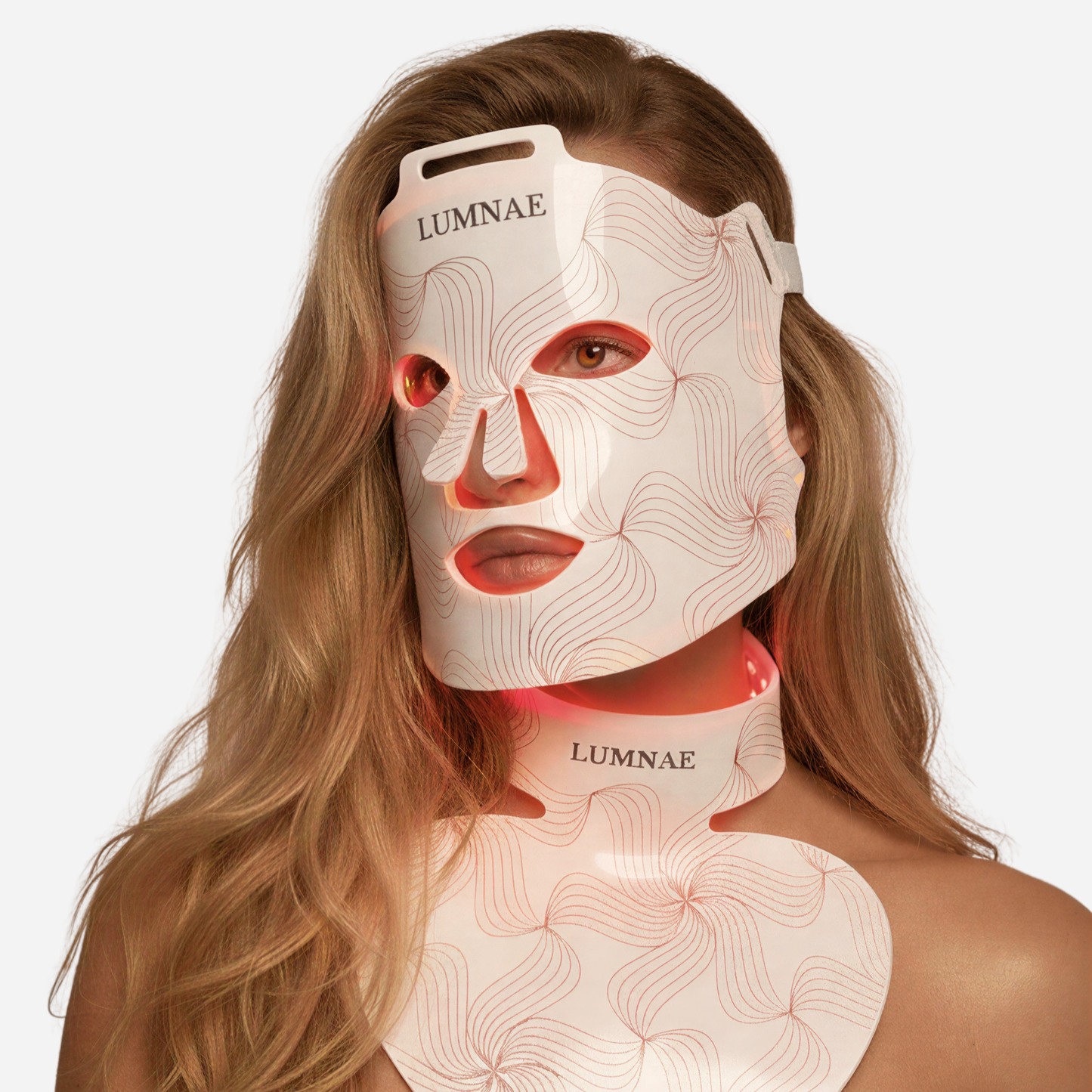
The Lumnae LED Mask — Mode 2 for rosacea erythema, Mode 1 for barrier repair. FDA-cleared, CE-certified, 488 medical-grade LEDs. Available now on lumnae.com with UAE delivery.
Discover the Lumnae LED MaskThis article summarises published photobiomodulation research and is for educational purposes only. It does not constitute medical advice. Rosacea is a chronic condition — always consult a licensed dermatologist for a personalised diagnosis and treatment plan.