
LED Mask for Acne: The Complete Science Guide for Dubai & UAE Skin (2026)
Share
LED Mask for Acne: How Blue Light Therapy Really Works — A Complete Guide for Dubai Skin
How does blue light actually destroy acne bacteria? What does red light do to inflammation at the cellular level? And why does the UAE climate change how you should treat both? A clinically referenced, protocol-driven guide — no shortcuts.
- Acne is a four-stage cascade: excess sebum → clogged pores → bacterial proliferation → inflammation. An effective LED protocol must act on multiple stages — not just display a blue light labelled "anti-blemish".
- Blue light at 415nm destroys Cutibacterium acnes through porphyrin photosensitisation — a targeted photochemical mechanism, not a general antiseptic effect. Red light at 660nm reduces inflammatory cytokines and supports tissue repair.
- The Papageorgiou et al. landmark study found the combined blue-red protocol achieved 76% mean improvement in inflammatory lesions — significantly superior to either wavelength used alone or to benzoyl peroxide.
- Results are cumulative. Short, regular sessions (10 min, 3–5× per week) outperform long, irregular ones. Visible improvement typically begins at weeks 2–3 and stabilises by week 8.
- The UAE and GCC climate — heat, AC dehydration, year-round UV, humidity — makes LED uniquely suitable: UV-free, non-drying, barrier-supportive and appropriate for all skin tones year-round.
1. What is LED light therapy — and why does it matter for acne?
Photobiomodulation (PBM) is the application of specific wavelengths of non-ionising light to living tissue to produce a physiological response. Unlike lasers, which ablate tissue, or UV light, which damages DNA non-selectively, LED devices emit cold, non-ionising light that is absorbed by the skin without heat or injury.
The mechanism begins in the mitochondria. Skin cells contain light-sensitive receptors — most notably cytochrome c oxidase, a key enzyme in the mitochondrial respiratory chain — that absorb photons at specific wavelengths. This absorption triggers a cascade: increased ATP production (cellular energy), reduced oxidative stress, and the activation of repair pathways including collagen synthesis and anti-inflammatory signalling.
For acne specifically, two wavelengths are clinically relevant:
- Blue light (~415nm) — acts at the skin surface to destroy acne-causing bacteria through a targeted photochemical reaction involving porphyrins.
- Red light (~660nm) — penetrates more deeply to calm inflammation, stimulate collagen and accelerate tissue repair following bacterial activity.
Understanding what each wavelength does — and why both are necessary — is the foundation of any effective LED acne protocol.
2. How acne forms — the four-stage cascade
Effective treatment requires understanding acne as a biological process with a predictable sequence of events. Each stage offers a potential point of intervention, which is why multi-action LED protocols outperform single-spectrum approaches.
Stage 1 — Excess sebum production
Sebaceous glands produce sebum — a complex lipid mixture that lubricates skin. Production is regulated by androgens, which is why acne is linked to hormonal fluctuations, stress and genetics. In the UAE, ambient temperatures above 35°C demonstrably increase sebaceous secretion rate, making sebum overproduction a year-round challenge rather than a seasonal one.
Stage 2 — Follicular obstruction
Dead skin cells that fail to shed normally mix with excess sebum and obstruct the follicle. This comedone is not yet a spot — but it creates the oxygen-depleted, sebum-rich environment in which the next stage becomes inevitable.
Stage 3 — Bacterial proliferation
Cutibacterium acnes (C. acnes, formerly Propionibacterium acnes) is a gram-positive, anaerobic bacterium that inhabits hair follicles. In a blocked follicle, it proliferates rapidly, metabolising sebum triglycerides into free fatty acids and releasing irritating by-products. Critically, C. acnes also produces porphyrins as metabolic by-products — and this is the key to blue light therapy.
Stage 4 — Inflammatory response
The immune system responds to bacterial activity with inflammation: neutrophils infiltrate the follicle, pro-inflammatory cytokines (IL-1β, TNF-α, IL-6) are released, and the visible signs of acne appear — redness, swelling, pain. If the follicle ruptures, inflammation extends into surrounding dermis, increasing scarring risk and post-inflammatory hyperpigmentation (PIH).
This sequence explains why single-action treatments so often underperform: topical antibiotics that target only bacteria leave inflammation unresolved. Treatments that target only inflammation ignore the bacterial root cause. A combined blue-then-red LED protocol acts on stages 3 and 4 simultaneously — which is the biological rationale for the sequenced approach.
3. How blue light at 415nm destroys acne bacteria
The antibacterial effect of blue light on C. acnes is not a general antiseptic effect. It is a specific, wavelength-dependent photochemical reaction that exploits a metabolic characteristic unique to acne-causing bacteria.
The porphyrin mechanism — in detail
As part of its normal metabolism, C. acnes synthesises porphyrins — specifically coproporphyrin III and protoporphyrin IX. These molecules have a strong absorption peak in the 400–420nm range. When light at ~415nm is absorbed by these porphyrins, it excites them from their ground state to a singlet excited state. This excitation is transferred to molecular oxygen in the surrounding environment, generating singlet oxygen (¹O₂) — a highly reactive species that damages the bacterial cell membrane through lipid peroxidation and leads to bacterial death.
This process is self-limiting: it depends on the presence of porphyrins specific to C. acnes. Surrounding human skin cells — which do not synthesise the same porphyrins — are not significantly affected. The result is targeted bacterial destruction without collateral tissue damage.
Ashkenazi et al. confirmed that C. acnes produces endogenous porphyrins with no need for external trigger molecules, and that illumination with blue light at 407–420nm produced bacterial destruction of four to five orders of magnitude after two to three consecutive illumination sessions. The study confirmed the photodestruction mechanism operates through porphyrin-mediated singlet oxygen generation — not through UV or heat.
Ashkenazi, H., Malik, Z., Harth, Y., Nitzan, Y. — FEMS Immunology & Medical Microbiology, 35(1), 17–24, 2003. DOI: 10.1111/j.1574-695X.2003.tb00644.x · PubMed: 12589953
Why 415nm specifically?
The absorption spectrum of coproporphyrin III shows its strongest peak at approximately 408–415nm. Studies comparing antibacterial efficacy across the visible spectrum consistently find the 405–420nm range produces the greatest log-reduction in C. acnes viability per unit of energy delivered. Light at 450nm — also in the blue range — produces measurably weaker porphyrin activation. This is why devices specifying "415nm" are clinically more credible for acne than those that describe only "blue light" without a wavelength value.
Effect on sebum regulation
Beyond its primary antibacterial mechanism, repeated blue light exposure appears to modulate sebaceous gland activity. Sebocytes respond to blue light by downregulating lipid synthesis, reducing sebum volume per gland. This secondary effect takes longer to manifest — typically 3–4 weeks of consistent use — but contributes to the progressive skin stability observed in long-term LED users: fewer bacteria, less fuel for those bacteria, fewer breakouts.
"The photodynamic inactivation of Propionibacterium acnes by blue light is mediated predominantly by endogenous porphyrins and results in significant reductions in bacterial viability at clinically achievable irradiance levels, without damage to surrounding keratinocytes."
Ashkenazi et al. — FEMS Immunology & Medical Microbiology, 2003
4. What red light at 660nm adds — repair, not just treatment
Blue light treats the cause. Red light manages the consequence. At 660nm, light penetrates beyond the epidermis into the dermis — the structural skin layer where fibroblasts, immune cells and vascular structures reside. Its primary actions are anti-inflammatory and regenerative.
Modulating the inflammatory cascade
Red light at 630–660nm interacts with cytochrome c oxidase in mitochondria, increasing ATP production and shifting the cellular redox environment. Downstream effects include reduced production of pro-inflammatory cytokines (IL-1β, TNF-α, IL-6) and upregulation of anti-inflammatory mediators. The result is a measurable reduction in redness, swelling and pain of inflammatory lesions — and a shorter post-breakout inflammatory phase.
For post-acne marks — the persistent redness or discolouration after a spot resolves — this is particularly relevant. Post-inflammatory hyperpigmentation (PIH) is sustained by low-grade inflammation continuing after the breakout itself resolves. Red light shortens this ongoing inflammatory stimulus, reducing both the duration and intensity of PIH.
Collagen stimulation and scar prevention
Red light activates fibroblasts — the dermal cells responsible for synthesising collagen and extracellular matrix proteins. Increased fibroblast activity means faster tissue remodelling, better quality repair and reduced risk of atrophic scarring. This is critical for adult skin, where repair capacity is slower than in adolescence and post-acne textural changes tend to persist longer.
Near-infrared (NIR) at 850nm — the deep layer
Some advanced LED devices include near-infrared light (around 850nm) alongside red. NIR penetrates to the subcutaneous layer, supporting cellular oxygenation, lymphatic drainage and deeper tissue repair. While not directly antibacterial, NIR enhances the overall repair environment of acne-prone skin — particularly useful for nodular or deeper lesions.
5. Wavelength comparison — what each spectrum does
| Spectrum | Wavelength | Penetration depth | Primary mechanism | Key benefit for acne |
|---|---|---|---|---|
| Blue | 415nm | Epidermis only | Porphyrin photosensitisation → C. acnes destruction | Reduces active breakouts, controls bacterial load |
| Red | 660nm | Epidermis + upper dermis | Cytochrome c oxidase → ATP ↑, cytokines ↓ | Resolves inflammation, fades post-acne marks |
| Near-Infrared | 850nm | Dermis + subcutaneous | Deep mitochondrial activation, lymphatic stimulation | Deep tissue repair, nodular lesion recovery |
| Yellow | 590nm | Epidermis + upper dermis | Lymphatic drainage, vascular response | Reduces surface redness, supports detoxification |
| RecommendedBlue + Red | 415 + 660nm | Multi-layer | Purify + repair in sequence | Complete acne protocol — treats cause and consequence |
6. What the clinical evidence actually shows
LED therapy for acne is one of the better-evidenced applications of at-home phototherapy. The following are the three most cited studies in the field — all verified and traceable.
107 patients with mild to moderate acne were randomised into four groups: blue light only, combined blue-red light, cool white light, and 5% benzoyl peroxide. After 12 weeks, the combined blue-red group achieved a mean 76% improvement in inflammatory lesions — significantly superior to blue light alone (at weeks 4 and 8), to benzoyl peroxide (at weeks 8 and 12), and to white light. This remains the foundational trial establishing the superiority of the combined protocol.
Papageorgiou, P., Katsambas, A., Chu, A. — British Journal of Dermatology, 142(5), 973–978, 2000. DOI: 10.1046/j.1365-2133.2000.03481.x · PubMed: 10809858
The most comprehensive systematic review of light therapies for acne to date, encompassing 71 randomised controlled trials and 4,211 participants. It confirmed that combined blue-red light phototherapy produced meaningful reductions in inflammatory lesion counts with high tolerability and no reported serious adverse effects. The review also noted that the evidence base for combined protocols was more consistent than for single-spectrum approaches.
Barbaric, J., Abbott, R., Posadzki, P. et al. — Cochrane Database of Systematic Reviews, 2016(9): CD007917. DOI: 10.1002/14651858.CD007917.pub2 · PMC: PMC6457763
A clinical evaluation of a consumer-grade LED device combining blue (~415nm) and red (~633nm) light for home use demonstrated statistically significant reductions in both inflammatory and non-inflammatory acne lesions, with patient-reported improvement in skin comfort from week 3. The study confirmed that at-home protocols, when used consistently, can achieve outcomes comparable to clinic sessions.
Sadick, N.S. — Journal of Drugs in Dermatology, 7(4), 347–350, 2008. Referenced in: Journal of Clinical and Aesthetic Dermatology — Evaluating the efficacy and safety of 415nm/633nm phototherapy
"Home LED devices using a combination of red and blue light can safely and effectively reduce acne by targeting both the bacteria and the resulting inflammation — with tolerability superior to most topical agents."
John S. Barbieri, MD, MBA — Dermatology Researcher, Harvard Medical School
A consistent finding across all studies is the importance of irradiance — the power of light delivered per unit area (mW/cm²). Clinical protocols typically use 30–90 mW/cm² for sessions of 8–20 minutes. Consumer devices achieving 30–50 mW/cm² can deliver therapeutic energy doses in 10-minute sessions. Devices with very low irradiance (under 10 mW/cm²) would require impractically long sessions to deliver equivalent energy — a key reason many inexpensive masks underperform.
7. Why the UAE and GCC climate creates specific acne challenges
Acne management advice written for European or North American conditions frequently misses the specific stressors of the UAE environment. The GCC climate presents a distinct combination of factors that most skincare protocols do not account for.
Summer temperatures regularly exceed 42°C, driving sebaceous glands into sustained overproduction. The constant transition between extreme outdoor heat and heavy air conditioning creates a cycle of acute dehydration followed by sweating, disrupting the skin barrier continuously. Outdoor humidity in summer (often 80–90% RH on the coast) promotes bacterial proliferation. Year-round UV intensity accelerates PIH in post-acne marks — particularly significant for medium-to-deep skin tones common across GCC populations. Fine desert dust settles on skin and interacts with sebum to block follicles.
Why aggressive topical treatments are particularly problematic in the UAE
Retinoids, high-percentage AHAs and benzoyl peroxide increase photosensitivity — a significant drawback with 340+ sunny days per year. They also impair barrier function, which is already compromised by AC-induced dehydration. Skin that is simultaneously battling UV exposure, barrier disruption and chemical sensitivity is more reactive, more prone to PIH and slower to recover from breakouts.
Why LED is specifically compatible with the GCC
- No UV, no photosensitisation risk. LED masks emit visible and near-infrared wavelengths only. They can be used before a beach day, during Ramadan, or in any season without adjustment.
- Non-drying. Unlike any chemical acne treatment, LED does not reduce sebum to the point of barrier disruption. It modulates, not strips — critical in an already dehydrating AC environment.
- Barrier-supportive. Red light actively supports barrier repair via collagen synthesis and fibroblast activation — counteracting the AC-to-outdoors dehydration cycle.
- PIH-conscious. The anti-inflammatory effect of red light directly addresses the prolonged inflammation driving PIH — particularly important for medium-to-deep skin tones where post-acne discolouration is more persistent.
- Year-round usability. No seasonal contraindications. No adjustment for sun exposure.
8. LED therapy and skincare compatibility
The timing and selection of products around LED sessions significantly affects both safety and efficacy. This is a frequently overlooked dimension of LED protocols.
| Ingredient | Before LED session | After LED session | Reason |
|---|---|---|---|
| Niacinamide | Avoid (wash off) | Recommended | Supports sebum regulation and barrier repair post-LED |
| Hyaluronic acid | Avoid | Recommended | Hydrates and reinforces the repair stimulated by red light |
| Centella asiatica | Avoid | Recommended | Anti-inflammatory synergy with red light's cytokine modulation |
| Retinoids (retinol, tretinoin) | Do not use | Use on non-LED evenings only | Photosensitising — increases light sensitivity |
| Vitamin C (L-ascorbic acid) | Do not use | Acceptable (stable formula) | Can generate ROS when activated by light — unpredictable interaction |
| AHAs / BHAs | Do not use | Use on non-LED evenings | Increase photosensitivity; can amplify irritation |
| Benzoyl peroxide | Do not use | Avoid same day | Photooxidation risk; can cause unexpected reactions |
| SPF / sunscreen | Remove before session | Apply as usual in morning routine | Blocks light transmission; does not interact with LED directly |
General rule: begin every LED session with clean, product-free skin. Apply skincare within 2–3 minutes of completing the session, when absorption is heightened. Reserve photosensitising actives for evenings when you do not use the mask.
9. The correct protocol — how to use an LED mask for acne
The structure of your sessions matters as much as the device. The following protocol is designed for acne-prone skin in a UAE/GCC context, optimised for the combined blue-then-red sequence.
Before every session
Cleanse with a gentle, pH-balanced cleanser. Remove all sunscreen, makeup and skincare residue. Pat dry and wait 60–90 seconds. A clear, product-free skin surface is required for optimal light transmission.
The purify and rescue sequence
Blue Light Only
Targets C. acnes bacteria at the skin surface through porphyrin photosensitisation. Reduces the bacterial load responsible for initiating new breakouts. Always begin with this phase.
Red + NIR + Yellow
Resolves inflammation, stimulates collagen repair and supports barrier recovery. This phase is not optional — it is the recovery half of the protocol. Never skip it after blue.
After every session
Apply a lightweight, non-comedogenic moisturiser or serum within 2–3 minutes. Prioritise: niacinamide (sebum regulation + barrier), hyaluronic acid (hydration), centella asiatica (anti-inflammatory). Avoid heavy occlusives and all photosensitising actives on the same day.
Recommended frequency
| Skin condition | Frequency | Session structure |
|---|---|---|
| Active breakouts | 5× per week | Blue 10 min → Red 10 min |
| Mild / occasional breakouts | 3–4× per week | Blue 10 min → Red 10 min |
| Post-acne marks only | 3× per week | Red + NIR 20 min |
| Maintenance (clear skin) | 2× per week | Red + NIR 10–20 min |
10. Timeline of results — what to expect and when
LED therapy does not produce immediate visible change. Its mechanism is biological — it shifts the skin's internal environment over repeated sessions. The following timeline is based on clinical data and assumes consistent use of 3–5 sessions per week.
Stabilisation begins — internal shifts before visible change
Bacterial load begins decreasing with each session. Sebum production starts to moderate. Existing breakouts may resolve slightly faster. Skin often feels less reactive by the end of week two — though visible changes are minimal at this stage.
Visible reduction in active breakouts
The cumulative antibacterial effect becomes visible: fewer new breakouts forming. Existing inflammatory lesions resolve more quickly. Skin texture begins to even out. This is the point at which most users first notice meaningful change.
Significant improvement in marks and texture
Post-inflammatory marks begin to fade as red light's collagen stimulation accelerates tissue remodelling. Sebum production is noticeably more regulated. Breakout frequency is substantially reduced. Skin appears more uniform, less reactive — even without makeup.
Maintenance — sustaining the gains
LED transitions from active treatment to maintenance tool. Reducing to 2–3 sessions per week sustains results. Continued use supports collagen quality, sebum regulation and barrier integrity — preventing conditions that would allow acne to return.
11. LED therapy vs other acne treatments
LED occupies a specific position in the acne treatment landscape — not a medical-grade intervention, but far from cosmetic. Understanding where it sits relative to other approaches helps set realistic expectations.
| Criterion | LED mask | Topical acids / BPO | Oral antibiotics | Isotretinoin |
|---|---|---|---|---|
| Skin tolerance | Generally high | Variable — dryness, irritation | Good with monitoring | Significant dryness |
| Barrier impact | Supportive (red light) | Disruptive at high concentrations | Neutral | Significantly disruptive |
| UV sensitivity | None added | Increased (retinoids, AHAs) | Some antibiotics increase it | Significantly increased |
| Acts on inflammation | Yes (red light) | Indirectly | Yes | Yes |
| Long-term use | Yes — maintenance | Limited by tolerance | Not recommended (resistance) | Typically a single course |
| Medical supervision | Not required | Advisable for strong formulas | Required | Required |
| Best suited for | Mild–moderate, maintenance, sensitive skin, GCC climate | Surface-level blemishes | Moderate–severe acne | Severe / cystic acne |
LED is not a replacement for dermatologist-prescribed treatment when that is clinically indicated. Severe, cystic or nodular acne warrants medical input. However, for the majority of adults managing mild-to-moderate acne — particularly those who have experienced dryness and irritation from topical treatments — LED occupies a genuinely useful, evidence-supported role.
12. How to choose an LED mask that actually works for acne
The at-home LED market has expanded rapidly and unevenly. These are the criteria that separate credible devices from cosmetic theatre.
Exact wavelength specification
A credible device specifies wavelengths in nanometres: 415nm (±10nm) for blue, 630–660nm for red. Vague descriptions like "blue light" or "anti-blemish mode" without nm values are a red flag. The antibacterial mechanism of blue light is wavelength-dependent — light at 470nm produces measurably weaker porphyrin activation than 415nm.
Credible irradiance
Effective LED therapy requires sufficient light intensity (irradiance), measured in mW/cm². Clinical protocols use 30–90 mW/cm² for 8–20 minute sessions. Consumer devices at 30–50 mW/cm² deliver therapeutic doses in 10-minute sessions. Devices that do not publish irradiance data are treating it as an afterthought.
Full-face, homogeneous LED coverage
Coverage gaps are common in rigid plastic masks that cannot lie flush against the full face. Medical-grade silicone that conforms to the face — including the chin and jaw where hormonal acne most commonly presents — ensures consistent light delivery across the full treatment area.
Multiple distinct modes
Separate blue, red, red+NIR and combination modes allow the protocol to evolve as skin changes: from active breakout, through post-acne repair, to long-term maintenance. Fixed-mode devices cannot be optimised across these phases.
Certification
CE certification and FDA clearance are baseline safety indicators. The Lumnae LED Mask holds both, along with ISO 13485 compliance — the international standard for medical device quality management.
13. Frequently asked questions
- Acne is a four-stage cascade. LED protocols must address bacteria (blue light) and inflammation (red light) simultaneously — not just one.
- Blue light at 415nm destroys C. acnes through porphyrin photosensitisation — a targeted photochemical mechanism, not a general antiseptic.
- Red light at 660nm reduces pro-inflammatory cytokines, stimulates collagen and accelerates post-acne repair. It is the recovery half of the protocol — not optional.
- Three verified clinical studies confirm the combined blue-red protocol produces statistically significant lesion reduction with high tolerability. The landmark Papageorgiou trial found 76% mean improvement after 12 weeks.
- The UAE and GCC climate makes LED uniquely compatible: UV-free, non-drying, barrier-supportive and safe for all skin tones year-round.
- Results require consistency: 3–5 sessions per week, 10 minutes per phase. Regularity matters more than intensity or duration.
- Device quality is the limiting variable: precise wavelengths, credible irradiance (30–50 mW/cm²), full-face silicone coverage and CE/FDA certification separate effective devices from cosmetic theatre.
The Lumnae LED Mask — Built for the GCC Standard
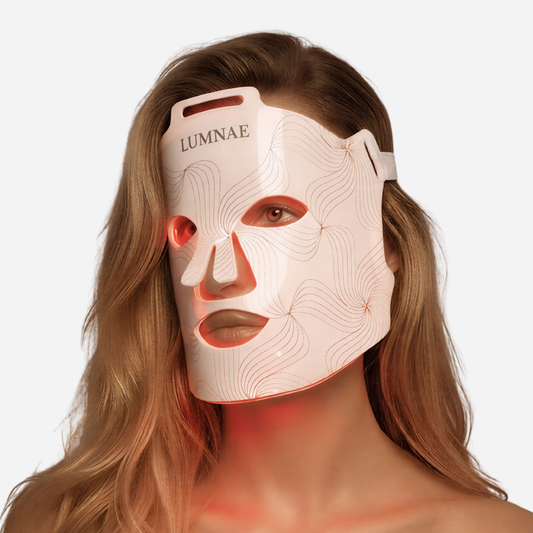
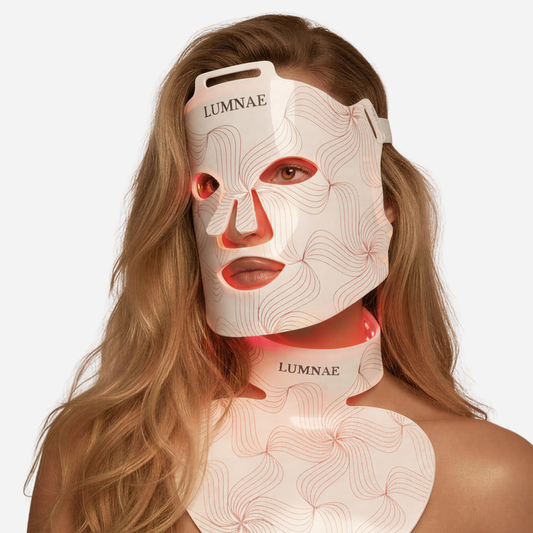
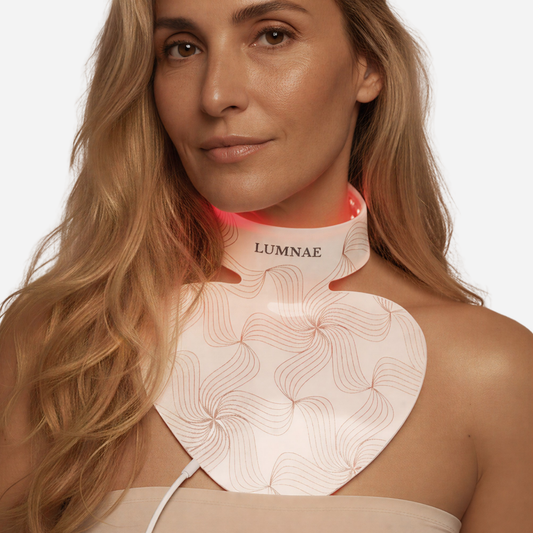
The Lumnae LED Mask was developed with the science above as its foundation. Not as a single-mode "anti-acne" device, but as a complete phototherapy system with six distinct modes — allowing the full Purify + Rescue sequence and the flexibility to adapt as skin evolves from active breakout through post-acne repair to long-term maintenance.
Medical-grade silicone construction ensures a flush, full-face fit — including the chin and jaw line where hormonal breakouts present most commonly in GCC skin. No UV. No significant heat. FDA-cleared, CE-certified, ISO 13485 compliant. Compatible with year-round use in the UAE climate, including the highest-sun months.
For skin shaped by the specific pressures of living in the Gulf — the AC-to-outdoors temperature shock, the humidity, the dust, the continuous sun — a device that treats without stripping, repairs without sensitising, and integrates into a daily routine without friction.
Begin Your Protocol
Professional-grade LED therapy, clinically structured and designed for the realities of Dubai and GCC skin.
Discover the Lumnae LED Mask ✦- Papageorgiou, P., Katsambas, A., Chu, A. (2000). Phototherapy with blue (415 nm) and red (660 nm) light in the treatment of acne vulgaris. British Journal of Dermatology, 142(5), 973–978. DOI: 10.1046/j.1365-2133.2000.03481.x · PubMed: 10809858
- Barbaric, J., Abbott, R., Posadzki, P. et al. (2016). Light therapies for acne. Cochrane Database of Systematic Reviews, 2016(9): CD007917. DOI: 10.1002/14651858.CD007917.pub2 · PMC: PMC6457763
- Ashkenazi, H., Malik, Z., Harth, Y., Nitzan, Y. (2003). Eradication of Propionibacterium acnes by its endogenic porphyrins after illumination with high intensity blue light. FEMS Immunology & Medical Microbiology, 35(1), 17–24. DOI: 10.1111/j.1574-695X.2003.tb00644.x · PubMed: 12589953