
Red Light Therapy for Anti-Aging & Collagen: What Really Works
Red Light Therapy for Anti-Aging
& Collagen: What Really Works
Sun all year, air-conditioning all day, late nights. Gulf life is hard on collagen. Here is what red light actually does inside your skin, what the studies measured, and the exact routine to follow at home.
Collagen is your skin's scaffolding, and it fades
Collagen is the protein that keeps skin firm, plump and smooth. Your body makes less of it every year, and the Gulf lifestyle speeds things up.
From adulthood, skin loses about 1% of its collagen every year. By 40, that is a lot of scaffolding gone, which is why lines appear and the jawline softens.
Shuster et al., 1975UV breaks collagen down
UV light activates enzymes that cut collagen fibres. In the Gulf, the UV index stays high almost all year.
Dry, tired skin
Cold, dry indoor air weakens the skin barrier, so fine lines look deeper and skin looks dull.
Collagen can be stimulated
Your collagen factories (fibroblasts) can be encouraged to work harder. That is exactly what red light does.
What happens inside your skin in 10 minutes
1. Light goes in
Red (660 nm) and near-infrared (850 nm) light pass through the skin's surface.
2. Cells absorb it
Tiny power plants in your cells, the mitochondria, capture the light.
3. More energy
They produce more ATP, the energy molecule every cell runs on.
4. More collagen
Energised fibroblasts produce more collagen and elastin, while less is broken down.
Red light is like a phone charger for your skin cells. Charged cells do their job better, and their job is making collagen.
What researchers actually measured
Not promises, measurements: wrinkle depth, skin density on ultrasound, collagen under the microscope.
Deeper results month after month
20 volunteers used a 630 nm LED mask for 12 minutes, only twice a week. Every volunteer saw an overall improvement in skin quality, and results largely held 4 weeks after stopping.
Couturaud V et al., Skin Research and Technology, 2023Red vs near-infrared, side by side
A randomized, placebo-controlled, double-blind study used 633 nm and 830 nm light on half of each face. Biopsies showed more collagen and elastic fibres on the treated side.
Lee SY et al., J Photochem Photobiol B, 2007Collagen you can see on ultrasound
Compared with a control group, red and near-infrared light improved complexion, skin feel, roughness and wrinkles, and increased collagen density measured by ultrasound.
Wunsch A, Matuschka K, Photomed Laser Surg, 2014More collagen made, less destroyed
The same 660 nm red used in the Lumnae mask boosted collagen production and slowed its breakdown. Wrinkles and texture also improved in volunteers.
Barolet D et al., J Invest Dermatol, 2009Four modes for younger-looking skin
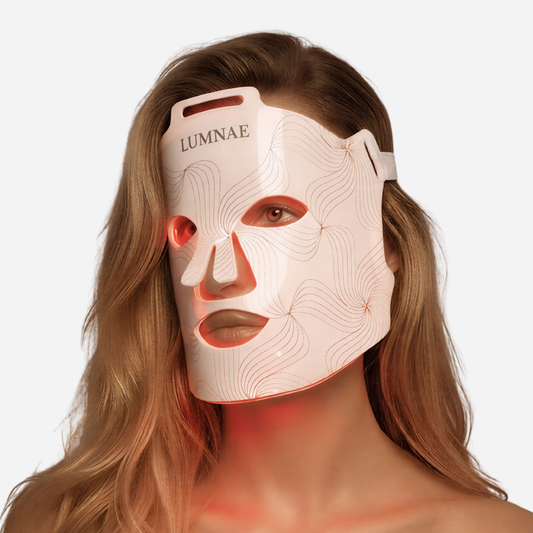
Aging is not only lines: it is also tone, glow and texture. The Lumnae mask has a mode for each.

M3 Anti-aging
660 nm red + 850 nm near-infrared: collagen support at two depths, for fine lines and firmness.

M4 Morning
The most powerful mode, up to 45 mW/cm². Fresh, luminous skin before your day.

M2 Rejuvenation
Sun spots age a face as much as lines. Yellow and red for a more even tone.

M1 Repairing
Red only, for days when your skin feels tight or reactive.
Every mode runs 10 minutes, with 3 intensity levels (50, 75, 100%) and an optional 10 Hz pulse mode. Full details in our mode guide.
The anti-aging week
4 to 5 sessions a week, one a day. M3 in the evening while your skin winds down, M4 on a couple of mornings for glow.
Clean, dry skin
No serum, oil or SPF under the mask. Start at Level 1 for the first week, then increase.
Feed your skin
Peptides or hyaluronic acid after M3, vitamin C then SPF 50 after M4. Retinol on evenings without LED.
Your skin, month by month
A fresher glow, skin looks rested. Friends may ask what you changed.
Texture is smoother and fine lines start to soften.
Firmer-looking skin, softer lines, a more defined oval.
Keep 2 to 3 sessions a week and daily SPF to maintain your results.
What people get wrong about red light
"It's like UV, it will age my skin"
Fact: LED light therapy contains no UV. It does not tan, burn or make your skin sensitive to the sun.
"Only clinics have devices that work"
Fact: The 2023 study above used a home LED mask. What matters is the right wavelengths and regular use.
"More sessions means faster results"
Fact: Light works with a sweet spot. 3 to 5 sessions a week beat daily marathons.
"I'll see results in a week"
Fact: Glow comes fast, collagen takes time. Count 8 to 12 weeks for firmness and lines.
"It's only for wrinkles"
Fact: The same mask also helps with tone, glow and blemishes, with 6 modes.
"It replaces SPF"
Fact: Never. Light helps build collagen, SPF protects it. In the Gulf, you need both.
The neck tells your age first
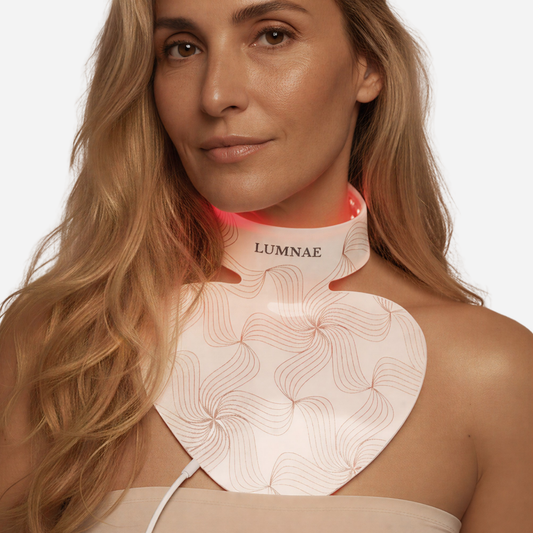
The neck and décolleté have thinner skin and see just as much sun, yet they are the most forgotten zones.


Your questions, answered
Does red light therapy really boost collagen?
Research says yes. Red light gives your skin cells more energy (ATP), and the fibroblasts that make collagen work harder. In a lab model, 660 nm light increased procollagen by 31%, and a split-face trial found more collagen fibres on biopsy.
How long until I see a difference?
A fresher glow within 2 to 4 weeks. In a 2023 study using a red LED mask twice a week, wrinkle depth was 16% lower after 1 month and 38% lower after 3 months. Plan on 8 to 12 weeks for firmness and lines.
Which Lumnae mode is best for anti-aging?
M3 Anti-aging 3 to 4 evenings a week, plus M4 Morning on 1 to 2 other mornings. 4 to 5 sessions of 10 minutes a week.
Is it safe with the UAE sun?
Yes. LED light contains no UV and does not make your skin sun-sensitive. Keep SPF 50 every morning to protect your results.
Can I combine it with Botox, fillers or retinol?
Yes, they work differently. Keep retinol for evenings without LED, and ask your practitioner when to resume sessions after an injectable treatment.
What about my neck and décolleté?
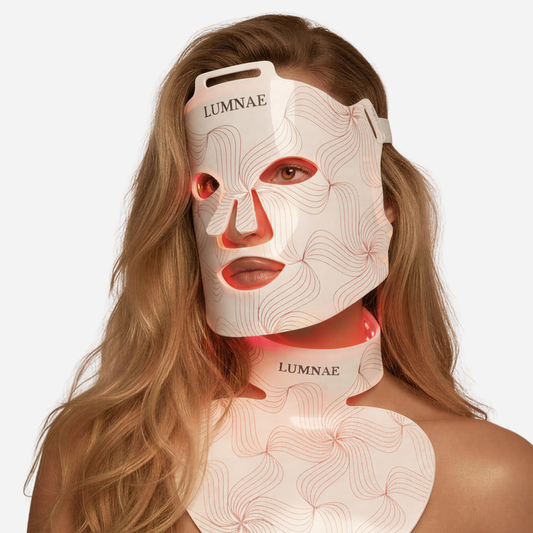
The Neck & Décolleté mask uses the same 4 wavelengths, and the Face & Neck kit covers both in one ritual.
FDA 510(k) cleared, 488 LEDs, 660 nm + 850 nm in Mode 3. Free next-day delivery in the UAE, pay in 4 with Tabby or Tamara.
Lee SY et al. A prospective, randomized, placebo-controlled, double-blinded, split-face clinical study on LED phototherapy for skin rejuvenation. J Photochem Photobiol B, 2007.
Wunsch A, Matuschka K. A controlled trial to determine the efficacy of red and near-infrared light treatment in patient satisfaction, reduction of fine lines, wrinkles, skin roughness, and intradermal collagen density increase. Photomed Laser Surg, 2014.
Barolet D et al. Regulation of skin collagen metabolism in vitro using a pulsed 660 nm LED light source. J Invest Dermatol, 2009.
Shuster S, Black MM, McVitie E. The influence of age and sex on skin thickness, skin collagen and density. Br J Dermatol, 1975.